A Founder's Guide to Vetting Energy Drink Manufacturers
Discover how to choose the right energy drink manufacturers. This guide covers formulation, compliance, MOQs, and vetting partners for your brand's success.
 Get a Free Quote Today!
Bringing a new energy drink from a wild idea to a can in someone's hand is a huge undertaking. Out of all the decisions you'll make, one stands above the rest: picking the right manufacturing partner.
This isn't just about finding a supplier. You're looking for an extension of your own team—a collaborator responsible for the quality, safety, and scalability of your entire brand. You need an R&D partner from concept through launch.
Turning Your Vision Into a Reality
This guide is for the brand founders, e-commerce entrepreneurs, and health-and-wellness visionaries looking to make their mark. We’ll pull back the curtain on the private-label manufacturing process so you can make a smart choice that takes your idea from a napkin sketch to a successful product launch.
Your choice of energy drink manufacturers will define your speed to market, the quality of your drink, and ultimately, your brand's reputation. It’s not a simple transaction; it's a partnership. The best partners act as your in-house R&D team, working with you from the first concept all the way through to launch day.
Why Your Manufacturing Partner Is Your Most Critical Asset
Think of your manufacturer as the engine of your brand. A brilliant concept is just that—a concept—without the right crew to actually build it. Your partner is the one who translates your vision into a physical product, making sure every single can meets strict standards for safety, taste, and consistency.
As you get ready to launch, understanding the fundamentals of a good partnership is key. Brushing up on essential vendor relationship management best practices will set you up for a long and successful collaboration. Trust and clear communication are completely non-negotiable.
Here’s what a great manufacturing partner brings to the table:
- Quality & Compliance: Your reputation is built on safety and quality. A top-tier manufacturer will operate out of a cGMP, UL certified, and FDA-registered facility. They'll also use third-party testing to prove every claim you make on the can is true.
- Customization & Flexibility: Your formula is your secret sauce. Your partner needs the ability to tailor that formula, nail the flavor profile, and offer flexible packaging options. Crucially, they should handle everything from small pilot batches to full-scale production runs.
- Speed & Reliability: The market doesn’t wait. You need a partner who can keep up. Look for rapid turnarounds, transparent timelines, and a solid track record of delivering on time so you can jump on opportunities without missing a beat.
Choosing a manufacturer is like choosing a co-founder. You need a partner who shares your commitment to quality, understands your vision, and has the technical expertise to bring it to life flawlessly.
At the end of the day, the right manufacturer does a lot more than just fill cans. They build the entire operational framework that allows your brand to grow, providing the reliability and quality that earns customer trust. In the sections ahead, we’ll dive into everything from formulation science and regulatory hurdles to packaging details and navigating minimum order quantities (MOQs). By the end, you'll have the clarity you need to pick the perfect partner for your journey.
So, You're Thinking About Launching an Energy Drink?
If you're looking to jump into the energy drink market, you're stepping into one of the most exciting and fast-paced arenas in the beverage world. And for good reason. But for new brands, just showing up isn’t enough. You need to understand the lay of the land to survive, let alone thrive. The opportunity is huge, but so is the competition.
The global thirst for energy drinks has never been stronger. This isn't just some flash in the pan; it's a real shift in how people live and what they consume. From desk jockeys needing a 2 p.m. pick-me-up to athletes chasing a new personal best, the demand for functional drinks is creating a massive opening for brands with a fresh take. Your first move is to figure out where this growth is happening and why.
A Market on the Move
The numbers don't lie. The global energy drink market hit roughly USD 107.20 billion in 2024 and is on track to rocket to USD 223.39 billion by 2033. That’s a compound annual growth rate (CAGR) of 8.5%, which signals some serious, long-term consumer interest. While North America has been the traditional heavyweight champion thanks to high disposable incomes, the Asia-Pacific region is the new up-and-comer. Emerging economies there are hungry for new flavors and brands. You can dig into the full market research to see exactly how these trends can work for you.
But this boom isn't just about selling more cans. It’s about a deeper change in what people actually want from their drinks. Today’s shoppers are label-readers. They’re looking for products that fit into their health and wellness routines, which has blown the doors wide open for brands that get it. They’re focusing on:
- Clean Ingredients: People are saying "no thanks" to artificial sweeteners and synthetic caffeine. Instead, they're reaching for natural sources like green tea extract, yerba mate, and guarana.
- Functional Benefits: It's not enough to just be an energy drink anymore. Consumers want more. Think formulations with nootropics for focus, adaptogens to help with stress, or electrolytes for better hydration. These are the drinks gaining real traction.
- Transparency: What’s in the can? Why is it there? Clear, honest labeling isn’t just a nice-to-have; it's how you build trust with your customers from the very first sip.
Standing Out in a Crowded Field
Let’s be honest: the market is dominated by giants like Red Bull and Monster. Their marketing firepower and distribution muscle are no joke. But their size can also be their biggest weakness. They're like massive battleships—powerful but slow to turn. This creates the perfect opportunity for nimble, direct-to-consumer brands to swoop in and own specific corners of the market.
The modern energy drink consumer isn't just buying caffeine; they're buying into a lifestyle. Your brand’s success hinges on connecting with a specific tribe—be it gamers, fitness enthusiasts, or wellness-focused professionals—with a product that speaks their language and meets their unique needs.
This is exactly where the right manufacturing partner becomes your secret weapon. A partner with deep expertise in areas like advanced botanical extraction and custom formulation isn’t just a vendor; they're your R&D collaborator. They can help you turn market trends into a tangible product that stands out on the shelf. By understanding these dynamics from the get-go, you can carve out your own space and build a brand people will remember.
The Core Manufacturing Process From Formula to Fulfillment
Taking your energy drink from a brilliant idea to a pallet of finished goods is a complex journey. This is where a true manufacturing partner proves their worth, acting as your guide through the maze of science, safety regulations, and scaling. The real work starts long before the first can is ever filled.
It all kicks off with Research & Development (R&D). Think of this as the creative and scientific heart of the whole operation, where your vision starts to become a reality. You'll work side-by-side with experienced formulators and food scientists to build your drink from the ground up. This isn't just about throwing caffeine and flavor into water; it's about crafting a unique functional beverage that actually delivers on its promise.
From Concept to Concrete Formula
The first real hurdle is translating what your brand stands for into a tangible list of ingredients. Do you want to sharpen focus with nootropics? Help athletes recover with electrolytes? Offer clean, sustained energy from botanical sources? The R&D team is there to help you source, balance, and perfect these components. This is a partnership from day one—it’s your vision, powered by our scientific know-how.
This phase gets granular, covering things like:
- Ingredient Sourcing: Finding and vetting suppliers for high-quality raw materials is non-negotiable. A great manufacturer has a deep network of trusted sources for everything, from the purest natural caffeine to the most obscure herbal extracts.
- Flavor Profiling: This is equal parts art and science. Our flavor chemists work their magic to create a taste that not only masks the sometimes-bitter notes of functional ingredients but also stands out in a crowded market.
- Stability Testing: We have to be sure your formula will taste, look, and perform the same on day one as it does on its expiration date. This critical step prevents ingredients from separating, degrading, or losing their potency over time.
If you want to go deeper on this first, crucial step, check out our guide on nutraceutical formulation development. It’s a detailed look at how to turn your big ideas into a safe, effective, and delicious product.
Once the formula is dialed in and you've signed off, we move from the lab to the production floor. This is where your validated recipe gets scaled up for its commercial debut.
This visual shows the journey your product will take, from today's market to the opportunities of tomorrow.
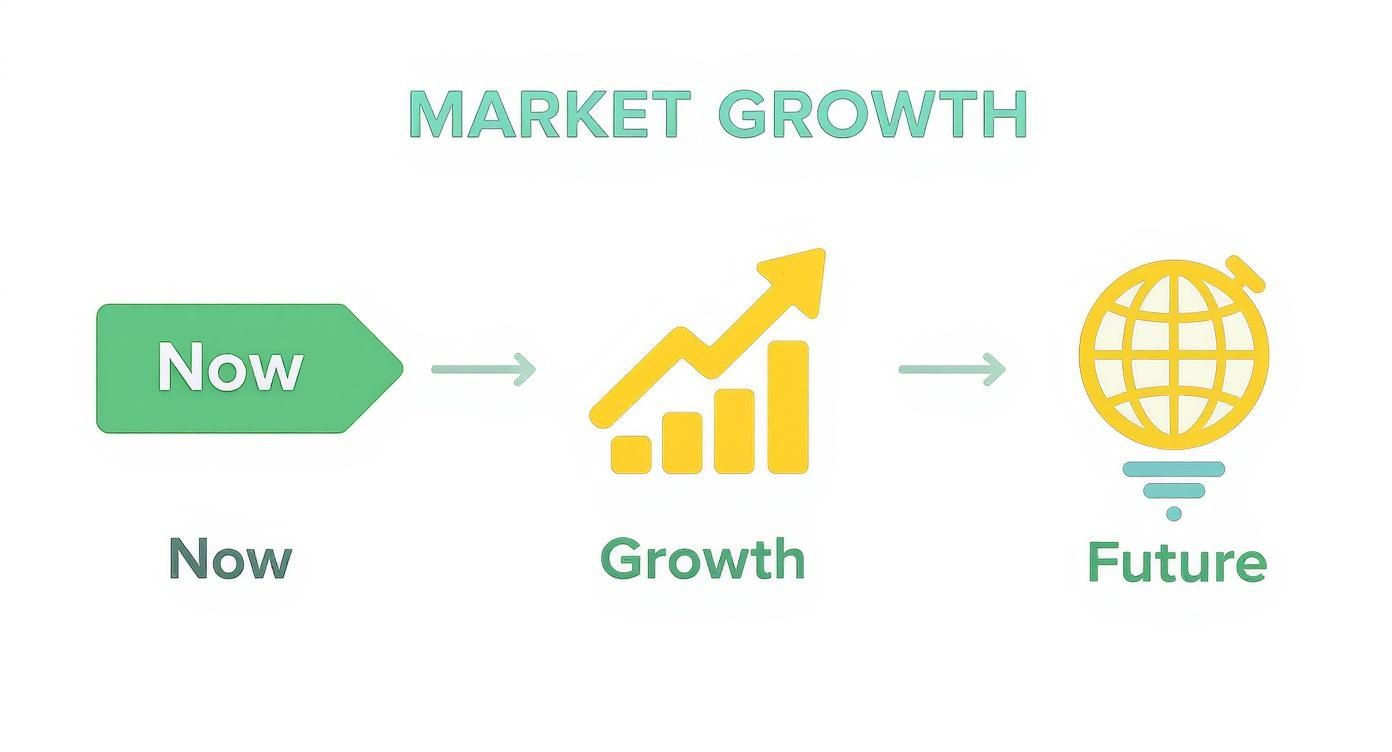
Having a solid manufacturing process is what allows you to actually seize those opportunities.
Scaling Up Production and Ensuring Quality
Before we go all-in, we start with a pilot run. This is a dress rehearsal—a small-scale batch that lets us test the formula in the real production environment. It’s a final sanity check to make sure everything works perfectly before committing to a full-scale run, saving you time and money by flagging potential issues early.
With a successful pilot in the bag, it’s time for the main event. Full-scale production unfolds in a few key stages:
- Batching and Mixing: Raw ingredients are weighed with extreme precision and blended in massive, industrial-grade tanks according to the master formula. There’s no room for error here; this is what ensures every single can is identical.
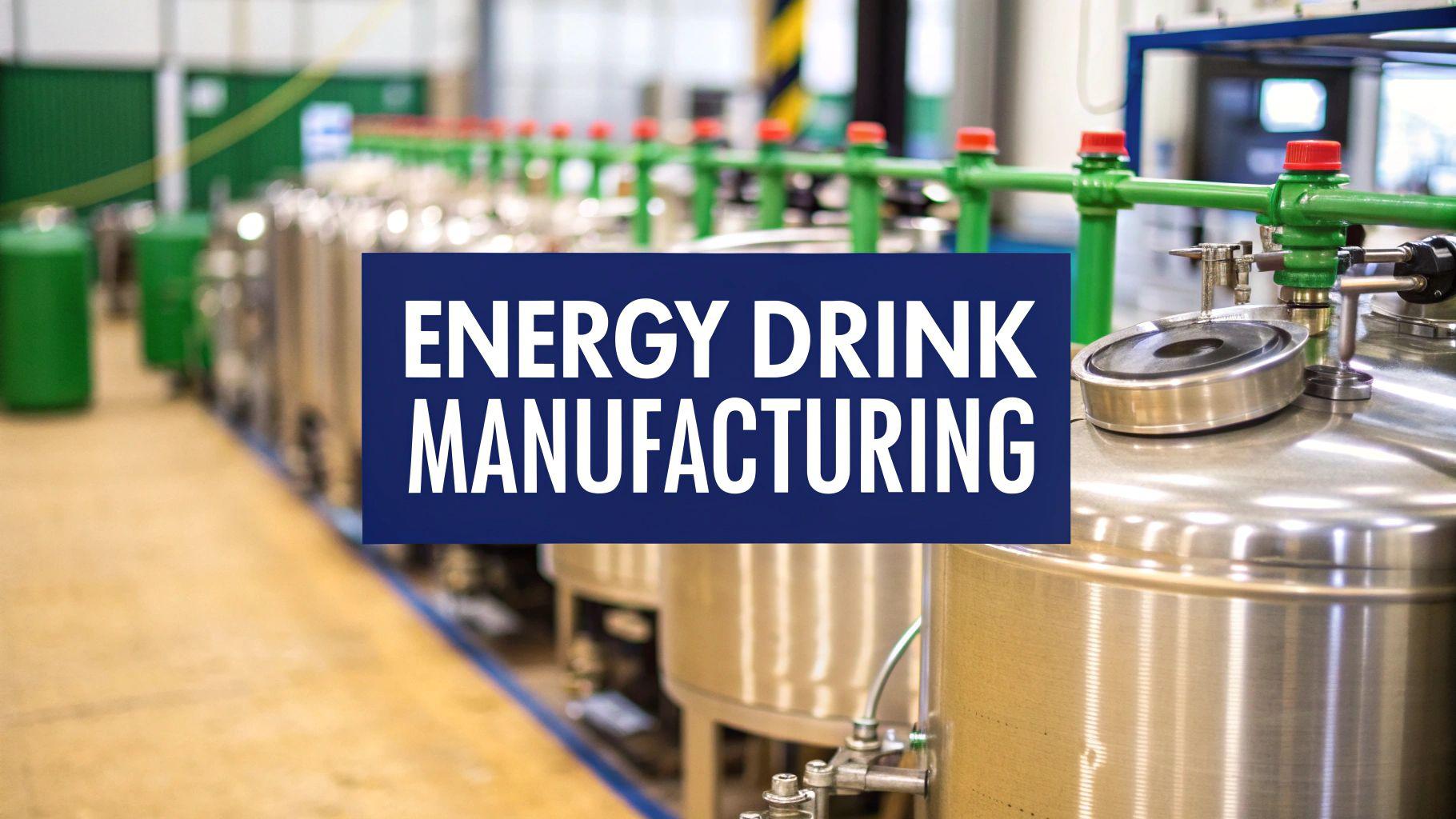
- Preservation and Pasteurization: To make the drink shelf-stable and safe, the liquid has to be treated to kill off any harmful microorganisms. We use advanced cold-fill technology, a modern technique that preserves the delicate flavors and nutritional value of sensitive botanicals far better than old-school heat pasteurization.
- Filling and Packaging: Finally, the finished liquid is pumped into cans or bottles, sealed, and labeled. High-speed, automated lines keep things efficient and consistent from the first can to the very last.
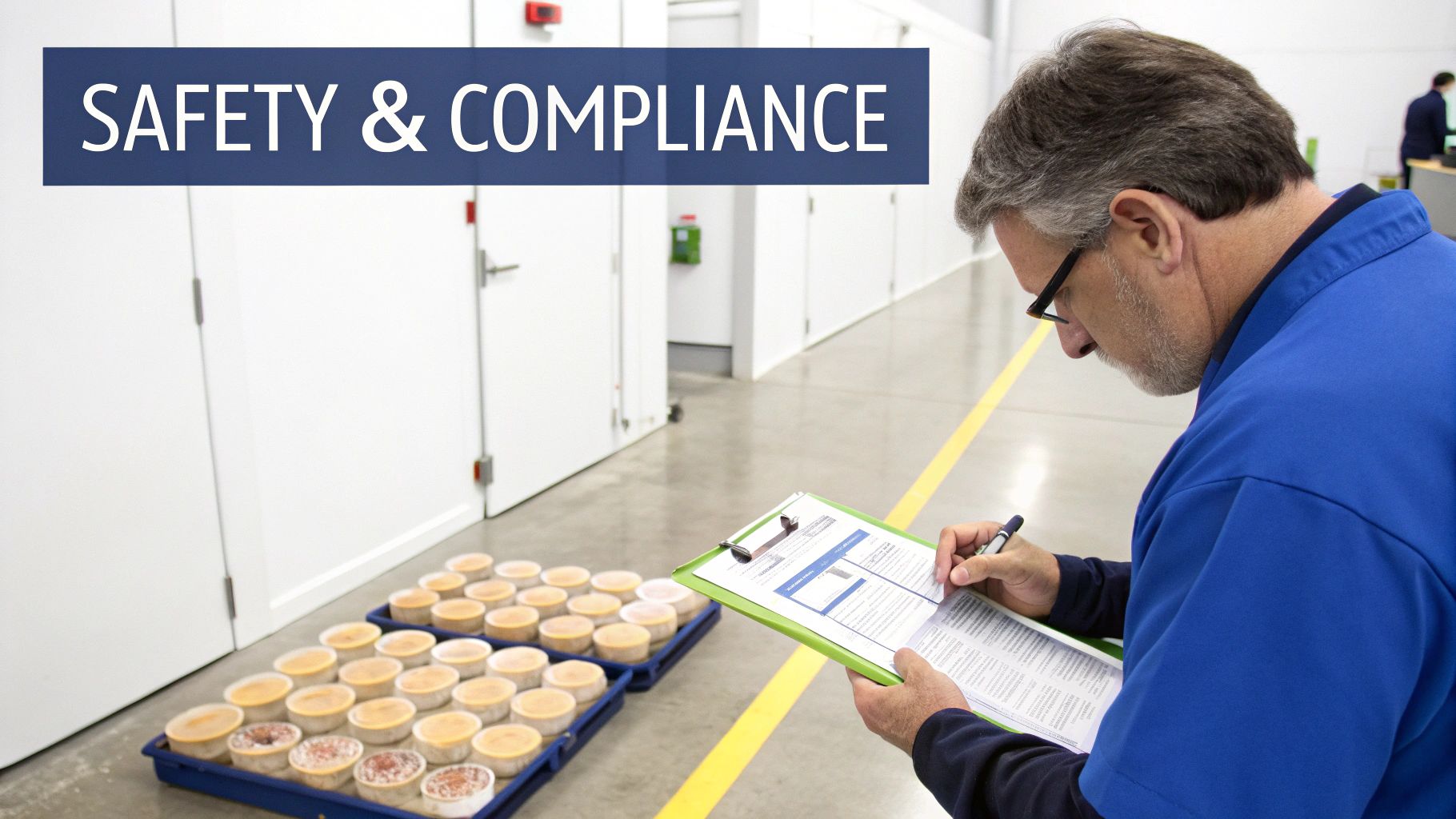
Quality control isn't a single step; it's a philosophy. It’s woven into every single stage of manufacturing, starting with raw material testing and continuing with in-process checks and final product analysis to guarantee safety, potency, and compliance.
After passing a final battery of quality checks, your product is packed into cases, stacked on pallets, and prepped for shipment. A reliable partner handles this entire fulfillment process without a hitch, ensuring your energy drink shows up on time and ready for your customers. That end-to-end capability is what separates a simple supplier from a true growth partner.
Navigating Critical Compliance and Quality Standards
Let's talk about the single most important thing that will make or break your energy drink brand: compliance. It isn't just a box to check—it's the foundation of your credibility. In a world where consumers read every label and question every ingredient, proving your product is safe, consistent, and high-quality is non-negotiable.
This is where your choice of energy drink manufacturer becomes a make-or-break strategic decision. Their certifications are your brand's first line of defense, a clear signal of their commitment to getting things right. These aren't just fancy badges for their website; they represent a deep, ongoing adherence to strict protocols that protect you and, most importantly, your customers.
Decoding Key Certifications
When you start vetting potential partners, you're going to see a lot of acronyms thrown around. Knowing what they mean is crucial for picking a manufacturer who will produce your drink to the highest possible standard.
Here are the absolute table stakes:
- cGMP (Current Good Manufacturing Practices): This is the big one, enforced by the FDA. cGMP certification means the manufacturer has proven systems for designing, monitoring, and controlling every single aspect of their facility and processes. It’s the gold standard for guaranteeing your product has the right identity, strength, quality, and purity. You can dive deeper into what a GMP certificate means for your brand in our guide.
- FDA-Registered Facility: This is the baseline. It means the facility is on the U.S. Food and Drug Administration's radar and is subject to their inspections. If a manufacturer isn't FDA-registered, walk away. It's a fundamental requirement for producing any food, beverage, or supplement for the U.S. market.
- UL Certification: You might associate UL with electronics, but they also provide critical safety certifications for food and beverage equipment and facilities. This certification is another layer of proof that a manufacturer's plant meets tough safety and sanitation standards, further minimizing your risk.
These certifications aren't isolated; they work together to create a powerful framework of accountability. They ensure that from the moment raw ingredients arrive to the second your final product is sealed, every step is documented, validated, and executed perfectly.
The Power of Third-Party Validation
In-house quality control is vital, but real trust is built on independent verification. The best manufacturers don't just mark their own homework; they invest in third-party testing to get an unbiased analysis of their products. This step is what separates the good from the great.
A third-party lab will typically test for:
- Potency: Does the drink actually have the amount of caffeine, B-vitamins, or other key ingredients that you claim on the label?
- Purity: Is the product clean and free from contaminants like heavy metals, pesticides, or microbes?
- Identity: Are the ingredients what the manufacturer says they are?
This external validation is your brand's ultimate insurance policy. It builds incredible consumer confidence and gives you the hard documentation you need to protect your brand.
E-Commerce Compliance for Amazon and Beyond
For most new brands, getting listed on platforms like Amazon is a top priority. But these e-commerce giants have their own maze of strict compliance rules, especially for supplements and drinks sold through Fulfillment by Amazon (FBA).
A manufacturing partner who understands FBA prep is worth their weight in gold. They'll ensure your product meets every labeling, packaging, and documentation requirement from day one, helping you avoid costly rejections or, even worse, account suspensions.
This expertise is more important than ever as the global market, valued at over USD 78 billion in 2024, sees explosive growth in natural and organic categories—a niche that faces even more scrutiny on these platforms.
Think of compliance as the passport for your product. Without the right stamps—cGMP, FDA registration, and third-party testing—your brand simply won't be allowed to travel to the places it needs to go, whether that's a major retail shelf or a customer's Amazon cart.
Key Considerations When Choosing Your Manufacturing Partner
Picking the right manufacturer is one of the most critical decisions you'll make for your brand. This goes way beyond comparing price sheets. You're choosing a partner whose capabilities will directly shape your product's quality, how fast you can grow, and your speed to market. This isn't just about finding a supplier; it's about finding a collaborator.
The difference between a simple supplier and a true R&D partner is massive. A supplier just fills orders. A partner, on the other hand, works with you on your formula from the initial idea all the way to a successful launch, acting like an extension of your own team. They bring deep industry experience to the table, helping you innovate and stay one step ahead of what customers want.
Customization and Production Flexibility
Your formula is your unique fingerprint in the market. Can a potential manufacturer actually handle the specialized ingredients you want to use, like that rare botanical extract or a specific blend of nootropics? The best energy drink manufacturers don’t just pull from a stock list of ingredients; they have the supply chain and technical know-how to bring your custom vision to life.
Beyond the formula itself, production flexibility is everything for new and growing brands. You need a partner who can support you at every stage of your journey.
- Pilot Batches: The ability to run small, initial batches is a game-changer. It lets you test your formula and dial in the flavor without a massive financial gamble.
- Scalability: As your brand takes off, can your manufacturer seamlessly scale up production from a few thousand cans to tens of thousands without quality dropping or lead times stretching out?
- Minimum Order Quantities (MOQs): Look for a partner with reasonable MOQs. Sky-high minimums can strangle your cash flow by tying it all up in inventory—a huge risk when you're just getting started.
A partnership mindset means your manufacturer’s success is tied to yours. They should be just as invested in perfecting your pilot run as they are in handling your largest production orders, offering flexibility that supports sustainable growth.
Speed, Reliability, and Global Awareness
In the fast-paced beverage industry, timing is everything. A reliable production timeline can be the difference between catching a market trend and missing it completely. When you're vetting partners, ask for their average lead times and their on-time delivery track record. Honesty here is a huge green flag for a well-run operation.
Understanding the bigger picture of the global market is also a sign of a sharp partner. The regional dynamics for energy drink manufacturers show how market leaders adapt to what different consumers want. For instance, North America led consumption in 2024, grabbing about 30.8% of the global market, while the Asia-Pacific region—producing around 53% of the world's supply—is seeing explosive growth. A partner who knows about these global shifts is better equipped to help you navigate supply chains and spot new opportunities. You can find more insights on the global energy drink market's regional dynamics.
As you dig into your options, you might come across resources for finding contract manufacturing sales representation. These can be useful for understanding the different business models and connections within the industry. At the end of the day, a successful launch comes down to finding a partner who is not only technically skilled but also transparent, communicative, and truly aligned with your brand's long-term vision.
Manufacturer Vetting Checklist
Choosing a manufacturing partner is a major commitment. Use this checklist as a scorecard to systematically evaluate and compare your options. It helps ensure you're looking at the full picture, not just the price tag.
| Evaluation Criterion | What to Look For | Why It Matters |
|---|---|---|
| Certifications & Compliance | cGMP, FDA-registered facility, UL or NSF certifications. | Non-negotiable. This ensures your product is made in a safe, clean, and federally compliant environment. |
| Ingredient Sourcing | Transparent supply chain, ability to source custom/specialty ingredients. | Guarantees the quality and authenticity of your formula. A weak supply chain can cause delays or quality issues. |
| MOQs & Scalability | Low MOQs for pilot runs, clear path to scale to larger volumes. | You need a partner who can grow with you, from your first test batch to your millionth can. |
| In-House Capabilities | R&D labs, flavor specialists, in-house testing, packaging expertise. | An all-in-one partner simplifies the process, reduces communication errors, and speeds up your timeline. |
| Communication & Support | A dedicated point of contact, responsive communication, proactive problem-solving. | You're building a relationship. Good communication is the foundation of a partnership that can navigate challenges. |
| Track Record & References | Case studies, client testimonials, and references you can speak with. | Proof is in their past performance. See if they have experience with brands similar to yours. |
| Pricing Transparency | Clear, itemized quotes. No hidden fees for formulation, testing, or storage. | You need to understand your true cost of goods to price your product correctly and manage your budget. |
After you've done your homework and compared a few candidates using this checklist, you'll have a much clearer idea of which manufacturer is the right long-term partner to help bring your energy drink brand to life.
The Vetting Process: A Practical Checklist and RFP Template
Selecting the right manufacturing partner is where all your research finally turns into action. This is the moment—the critical step that transforms your vision for an energy drink into something real you can hold in your hand. A methodical approach here will save you an incredible amount of time, prevent expensive misunderstandings, and ensure you find a team that genuinely gets what your brand is all about.
The key is to push past the surface-level sales pitches and dig into the nitty-gritty of what a real partnership looks like. You need a structured way to compare potential energy drink manufacturers side-by-side, making sure you’re judging them on the same crucial criteria. This process puts the power back in your hands, letting you make a decision based on the whole picture, not just a price tag.
Key Questions for Your Initial Consultations
Before you even think about sending out a formal request, your first calls should be all about fit and capability. Think of it as a chemistry check backed up by hard facts. During these early conversations, focus on getting a feel for their operational philosophy and how they treat their brand partners.
Here are some essential questions to get the ball rolling:
- Partnership Mindset: "Can you describe your ideal client? How do you collaborate with brands during the R&D and formulation stages?"
- Technical Capabilities: "What are your in-house capabilities for botanical extraction and flavor profiling? Do you use advanced techniques like cold-fill technology to preserve ingredient integrity?"
- Flexibility and Scale: "What are your typical minimum order quantities for a new product launch? What does the scaling process look like as our volume grows?"
- Compliance and Quality: "Can you walk me through your quality control checkpoints? How do you use third-party testing to validate label claims?"
Their answers will tell you everything you need to know. Do they see themselves as just another supplier, or are they a true collaborator invested in your success? A genuine partner will welcome these questions and give you transparent, detailed responses. For brands just starting out, understanding a manufacturer’s flexibility is absolutely critical; our guide on finding a low minimum supplement manufacturer offers more context on why this matters so much.
Streamlining Outreach with a Request for Proposal (RFP)
Once you’ve narrowed it down to a shortlist of promising candidates, it’s time to make your request official. A well-crafted Request for Proposal (RFP) is your single most powerful tool for getting clear, comparable, and accurate quotes. It forces you to define your project in detail and makes sure every potential partner is bidding on the exact same set of requirements.
An RFP isn’t just a request for a price; it's a blueprint for your project. It communicates your vision, technical needs, and business goals, setting the stage for a transparent and productive partnership from day one.
Your RFP should be a clear, concise document that covers:
- Project Overview: Briefly introduce your brand, who you're selling to, and what makes your drink special.
- Formula Concept: Detail your must-have ingredients, desired flavor profile, and any functional benefits you want to hit.
- Packaging Specifications: Specify your container (e.g., 12 oz sleek can), labeling requirements, and any needs for outer packaging like cartons or cases.
- Estimated Volumes: Give them your projected order size for an initial pilot run and your best guess for your first 12 months of volume.
- Project Timeline: Lay out your ideal timeline for key milestones, like finalizing the formula, the first production run, and your target launch date.
- Required Documentation: Ask for copies of their cGMP certificate, FDA registration, and examples of third-party testing reports.
Using this structured approach ensures the quotes you get back are truly apples-to-apples. It gives you the clarity and confidence to select a manufacturing partner who is perfectly equipped to bring your energy drink to life.
Energy Drink Manufacturing: Your Top Questions Answered
Diving into the world of beverage production can feel like a maze, especially for a first-time founder. We get it. That's why we've put together answers to the most common questions we hear from brand managers and entrepreneurs looking to partner with an energy drink manufacturer. Our goal is to cut through the noise and give you clear, straightforward information so you can move forward with confidence.
These aren't just random questions; they're the essentials. We'll cover everything from the initial investment and production timelines to the fundamental differences between manufacturing models. Getting a solid grip on these basics is the first step toward building a successful partnership and launching a drink that actually makes a splash.
How Much Does It Really Cost to Start an Energy Drink Brand?
This is always the first question, and the honest answer is: it depends entirely on your approach.
If you're dead set on a full custom formulation—creating a completely unique recipe from the ground up—you're looking at a significant upfront investment. Think somewhere in the ballpark of $150,000 to $250,000, and sometimes more. That number covers all the intensive R&D, sourcing unique ingredients, rigorous stability testing, and those initial pilot runs.
But there's another way. A private label or white label model dramatically lowers that barrier to entry. You’re essentially using a manufacturer's proven, pre-existing formula and just adding your own branding. This route can get you to launch for a much more manageable $30,000 to $60,000. It's a faster, less capital-intensive path, making it a fantastic option for brands that want to test the market without betting the farm.
What Are Typical Minimum Order Quantities (MOQs)?
MOQs are all over the map, and this is a major sticking point for new brands. The huge, established co-packers might not even talk to you unless you're ready to commit to 50,000 units or more for your first run. For a startup, that’s a massive—and often impossible—hurdle.
This is where a modern, flexible partner changes the game. Look for a manufacturer that is genuinely invested in your growth and offers accessible minimums, especially for pilot batches. Some will even go as low as a few thousand units. This kind of flexibility is a lifeline. It lets you manage your cash flow, avoid the risk of sitting on a mountain of inventory, and actually test your product with real customers before scaling up. A true partner wants to see you win, supporting you from that first small batch all the way to your biggest orders.
The right manufacturer for a startup is one who provides a clear and manageable path to scale. Starting with low MOQs allows you to validate your concept without tying up all your capital in inventory, giving you the runway to grow sustainably.
How Long Does It Take to Go From a Concept to a Can on the Shelf?
The timeline can swing wildly, from just a few months to well over a year. Again, it comes down to the path you choose.
A private label launch is your fast track. You can often go from idea to market in just 3 to 6 months. Why so fast? Because the core formula is already developed, tested, and ready to go. The main work involves locking in your branding, can design, and label.
Creating a custom formula is a much deeper dive. The R&D phase alone—which includes everything from ingredient sourcing and flavor profiling to stability testing—can easily take 6 to 9 months, if not longer. Once you've finally nailed the formula, you'll need another 2 to 3 months for the initial production run and getting it into your fulfillment center. A good manufacturing partner won't just give you a number; they'll provide a transparent, detailed timeline with clear milestones from day one.
Ready to turn your vision for a unique energy drink into a market-ready product? At Triton Nutra Group, we act as your dedicated R&D partner, offering flexible MOQs, in-house botanical extraction, and complete compliance support to ensure a seamless launch. Request your free consultation today!
