Your Partner in Building a 3rd Party Tested Supplement Brand
Discover what 3rd party tested really means for supplements. This guide covers testing, costs, and compliance to build brand trust and ensure quality.
 Get a Free Quote Today!
In a market flooded with supplement brands, how do you make yours stand out? More importantly, how do you prove your liquid herbal supplement is the real deal?
Third-party testing is your answer.
Think of it this way: an internal bookkeeper can manage a company's finances, but it's the certified public accountant—an independent outsider—who provides an audit that builds undeniable trust. Both roles are vital, but only the independent review offers unshakable proof of accuracy. This guide will walk you through how we, as your manufacturing partner, integrate this critical step to build your brand on a foundation of quality.
The Real Value of Third Party Tested Supplements
For any health and wellness entrepreneur, making claims about quality, purity, and potency is easy. Backing them up is another story entirely. This is where third-party testing steps in, transforming your marketing promises into verified facts. It’s an unbiased validation from an independent lab that confirms what's on your label is exactly what's inside the bottle.
This process isn't just another line item on your budget; it’s a strategic investment in your brand's reputation. At Triton Nutra Group, we see it as a non-negotiable step that underpins everything we stand for.
- Quality & Compliance: It gives you objective proof that your product not only meets cGMP standards in our FDA-registered, UL-certified facility but is also free from unwanted contaminants. This is the cornerstone of any robust supplement quality control procedures.
- Partnership Mindset: When we manage this entire process for you, we’re not just a supplier; we're your dedicated R&D partner, ensuring every single batch hits rigorous standards before it ever reaches your customers.
- Speed & Reliability: We build testing directly into our production timeline. This means no surprise delays—just a fully vetted, high-quality product delivered on your schedule, thanks to our transparent timelines and on-time delivery record.
A Foundational Investment in Brand Trust
Ultimately, a 3rd party tested seal becomes one of your brand’s most powerful credentials. It builds immediate confidence with savvy consumers who know what to look for, opens doors with major retailers like Amazon and Walmart, and provides a solid defense against regulatory scrutiny.
The real value here is the objective information it provides; you can learn more about how data-driven decision-making and transparency to enhance ROI in any industry.
Third-party testing moves your brand from simply making claims to providing proof. It’s the ultimate differentiator in an industry where consumer trust is paramount.
This commitment to independent verification is mirrored across the global market. The Testing, Inspection, and Certification (TIC) industry is a massive economic force, projected to hit USD 331.08 billion by 2030. Testing services make up the biggest piece of that pie, which tells you just how critical performance validation has become.
For e-commerce founders and brand managers, this isn't just an industry trend—it's the new standard for success. Partnering with a manufacturer who prioritizes and streamlines this process means you're building your brand on a foundation of verifiable quality right from day one.
Decoding the Most Critical Supplement Tests
When you see the phrase "3rd party tested" on a label, it shouldn't be a marketing buzzword. For a brand that's serious about quality, it's a verifiable promise to your customers. But what exactly is being tested? For any e-commerce founder or brand manager looking to build a reputable, long-lasting business, understanding these core tests is non-negotiable.
The process is straightforward: we send product samples to an independent, accredited laboratory that has zero affiliation with your brand or us as your manufacturer. Their sole job is to provide a completely unbiased analysis of your product's quality and safety.
Let's break down the four pillars of comprehensive supplement testing.
Potency: What Is Actually in the Bottle?
Potency testing answers your customer's most fundamental question: "Am I getting what I paid for?" This isn't just about honesty; it’s about efficacy. If your liquid supplement promises 500mg of Ashwagandha per serving, this test verifies that precise amount is in the formula.
Labs use advanced methods like High-Performance Liquid Chromatography (HPLC) to isolate and measure each active ingredient. Think of it as a highly sophisticated filter that separates every compound in your formula and counts it with pinpoint accuracy.
A passing potency test is your proof that the label claims are true, which is essential for building customer trust and complying with FDA regulations. It ensures your customers get the results they expect.
Purity: Is It Free From Harmful Contaminants?
While potency confirms the good stuff is in there, purity testing ensures the bad stuff is kept out. This is a critical safety check that protects your customers from harm and your brand from serious liability. It screens for a range of contaminants that can find their way into raw ingredients, especially botanicals.
Key things labs look for include:
- Heavy Metals: Searching for toxic elements like lead, mercury, arsenic, and cadmium, which can accumulate in soil and plants.
- Pesticides: Screening for residual pesticides and herbicides used during cultivation, ensuring levels are well below safe limits.
- Solvents: Confirming that no residual solvents from botanical extraction processes are left in the final product.
Failing a purity test is a major red flag that can trigger product recalls and do lasting damage to your reputation. That's why partnering with a manufacturer who rigorously vets their raw material suppliers is your absolute first line of defense.
Microbial Safety: Is It Safe to Consume?
Liquid supplements, especially those with natural ingredients and water, can be a breeding ground for microbial growth if not produced and preserved perfectly. Microbial testing is a non-negotiable step that checks for the presence of harmful microorganisms.
This analysis looks for:
- Total Plate Count (TPC): Measures the overall population of bacteria to ensure it's below a safe threshold.
- Yeast & Mold: Identifies any fungal contaminants that could spoil the product or cause harm.
- Pathogens: Screens for specific harmful bacteria like E. coli, Salmonella, and Staphylococcus aureus.
A clean microbial report proves the product was manufactured in a sterile, cGMP-compliant environment and is safe for your customers. It’s a direct reflection of your manufacturer’s commitment to quality.
Our advanced cold-fill technology and precise preservation systems are specifically designed to ensure your product passes these tests with flying colors, batch after batch. We cover this in more detail in our complete guide to lab testing for supplements.
Stability: Will the Quality Last?
Finally, stability testing answers a crucial forward-looking question: "Will this product still be potent and safe on its expiration date?" This is incredibly important for liquid formulas, where ingredients can degrade over time if not formulated correctly.
During stability testing, samples are kept in controlled chambers that simulate real-world shelf life, with variations in temperature and humidity. The product is then pulled and re-tested for potency and microbial safety at set intervals—say, 3, 6, 12, and 24 months.
The data from these tests justifies the "Best By" date on your packaging. It gives you the scientific evidence to confidently tell your customers that your product will be just as effective on the last day as it was on the first. This is a hallmark of a premium, trustworthy brand.
In-House Quality vs Third Party Verification
It’s a question we hear from new brands all the time: “My manufacturer already has quality control, so why pay extra for 3rd party tested verification?” It's an excellent question, and the answer is simple: they aren’t competing concepts. They are essential partners in a bulletproof quality system that protects both your brand and your customers.
Let's use an analogy. Think of a student grading their own homework. That's in-house QC. It’s a vital, first-pass check to catch obvious mistakes, ensure cGMP processes were followed, and confirm everything looks right on the surface.
Now, imagine the teacher grading that same assignment. That's third-party testing. It’s an unbiased, authoritative validation from an expert with no stake in the outcome other than accuracy.
Our Commitment to In-House Quality
As your manufacturing partner, our in-house QC is the bedrock of our entire operation. It’s a comprehensive process woven into every stage of production at our FDA-registered, UL-certified facility. This isn’t a quick look at the end; it's a relentless series of checkpoints.
This includes:
- Raw Material Inspection: Every ingredient arriving at our doors is immediately quarantined. We inspect it for identity, appearance, and proper documentation before it ever gets near a mixing tank.
- In-Process Monitoring: During production, we constantly monitor critical parameters like mixing times, temperature, and fill volumes to guarantee batch-to-batch consistency.
- Finished Product Review: Before a single bottle ships, we conduct final checks on packaging integrity, label accuracy, and tamper-evident seals to ensure your product is 100% retail-ready.
This rigorous internal system is crucial. It’s how we deliver on our commitment to speed and reliability by catching potential issues before they become costly errors or delays. But for building true brand authority, it’s only half the equation.
The Power of Independent Verification
While our internal team ensures the process is followed correctly, an independent third-party lab provides the final, objective proof that the product is exactly what it claims to be. This external validation is what builds unshakable confidence with consumers, major retailers like Amazon or Walmart, and even regulators.
It’s your proof that you’ve gone far beyond the minimum requirements to guarantee safety and efficacy.
Think of it this way: In-house QC verifies the process, while third-party testing verifies the product. For a premium supplement brand, both are non-negotiable.
This two-layer approach isn't just about compliance; it's a powerful statement in a market where consumers are savvier—and more skeptical—than ever before. In fact, the demand for this level of proof is exploding. The global Third Party Testing and Certification Service market was valued at around $50 billion in 2025 and is projected to hit nearly $85 billion by 2033. This growth is fueled by tougher regulations and consumers who demand transparency. You can explore more data on this expanding market to see where the industry is headed.
This trend makes one thing crystal clear: investing in a 3rd party tested program is no longer a "nice-to-have." It’s a core component of any successful, scalable, and trustworthy supplement brand. It’s the final seal of approval that tells the world you put your customer’s health and safety first.
How to Navigate Testing Labs Timelines and Costs
Bringing a new supplement to market involves many moving parts, and implementing a solid testing program can feel like another complex task on your to-do list. For health and wellness entrepreneurs, getting a handle on the logistics of 3rd party tested verification is what separates a smooth, successful launch from a stressful one.
It’s all about setting clear expectations for timelines, costs, and lab selection. This ensures you get that critical stamp of quality without throwing your go-to-market strategy off track.
As your manufacturing partner, we handle this entire process for you. We don't just search for "supplement testing labs" and hope for the best; we have a network of vetted, top-tier laboratories we’ve built relationships with over years. This lets us guarantee every lab meets our tough standards, so you can stay focused on building your brand.
Selecting a Qualified Testing Lab
Not all labs are created equal, especially when dealing with the nuances of botanical liquid supplements. Choosing the right one is a make-or-break step that directly impacts the validity and trustworthiness of your results. When we vet a lab partner, we look for a few non-negotiable credentials.
The absolute gold standard is ISO/IEC 17025 accreditation. This is an international standard that proves a lab has a sound quality management system and the technical competence to produce valid results. Think of it like a cGMP certification, but specifically for laboratories. It confirms they have meticulous protocols for everything from sample handling to equipment calibration.
Beyond that essential accreditation, we also verify a lab's specific expertise. A lab that’s great at testing pharmaceuticals might not have the right equipment or experience to accurately analyze complex botanical extracts. We ensure our partners have a proven track record in nutraceuticals and herbal analysis.
This diagram shows how in-house quality control and third-party testing fit together to create a verified product.
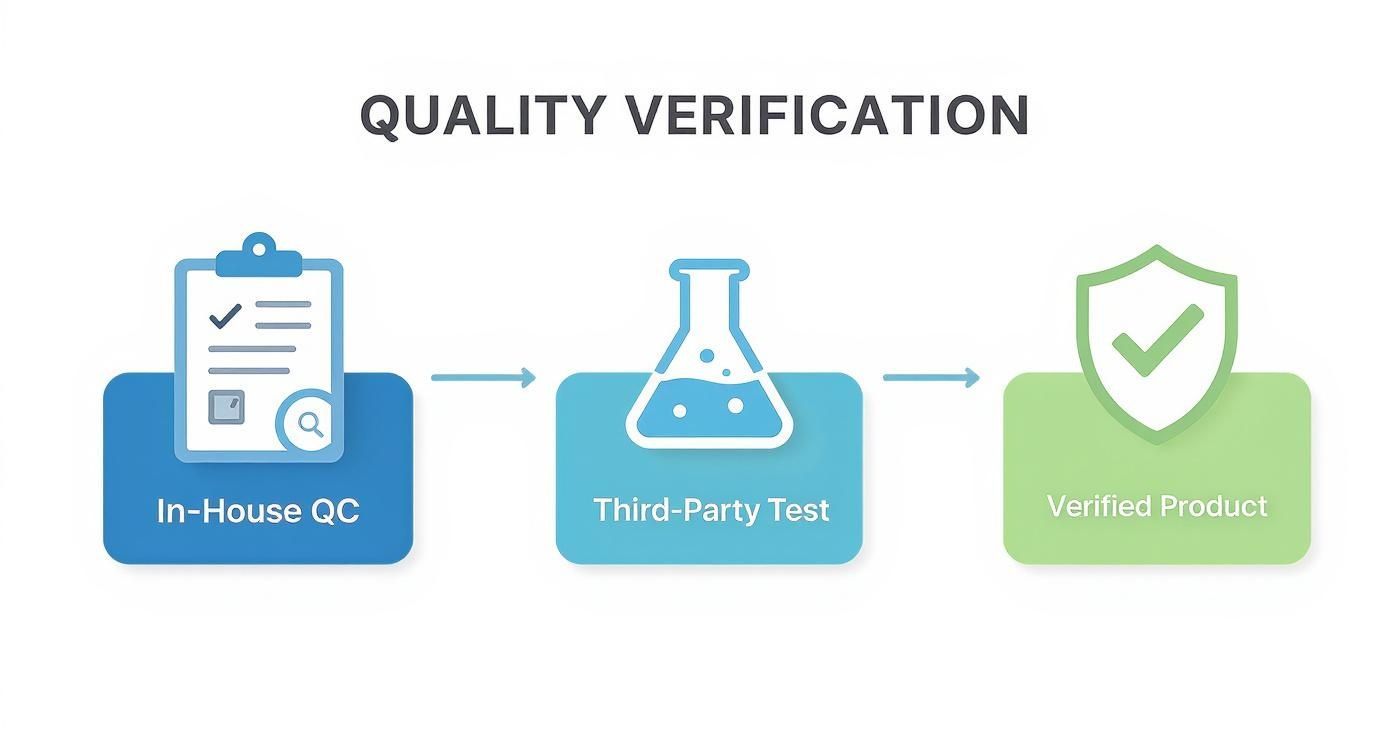
As you can see, independent lab testing is the final, authoritative step that elevates a quality-controlled product into a fully verified one.
Understanding Typical Timelines and Costs
One of the first questions brand owners ask is how testing will impact their production schedule and budget. Because we have established processes, testing fits seamlessly into your timeline, reinforcing our commitment to both speed and reliability.
A standard testing panel for a new liquid supplement usually has a turnaround time of 7-10 business days. That window covers sending the samples, the lab's analysis, and receiving the final Certificate of Analysis (CoA). We anticipate this step from day one, building it directly into your production schedule so it never becomes a bottleneck.
Now, for the costs. These can vary depending on your formula's complexity and the specific tests you need. To give you an idea, here are some realistic price ranges:
- Microbial Panel (Yeast, Mold, Pathogens): Usually costs between $100 - $250. This is a fundamental safety test for any liquid product.
- Heavy Metals Panel (Lead, Arsenic, Cadmium, Mercury): Typically runs from $100 - $300 and is crucial for any product with earth-grown botanical ingredients.
- Potency Testing (per active ingredient): The cost can range from $150 - $400+ for each active ingredient. More precise methods like HPLC are more resource-intensive, which is reflected in the price.
While these might look like extra expenses, they are a tiny fraction of what a product recall or reputational damage from a non-compliant product would cost. It's best to think of it as an insurance policy for your brand’s integrity.
By managing the lab relationships and building testing into our standard workflow, we take the mystery out of the process. Our approach provides you with transparent timelines and predictable costs, so you can plan your launch with confidence—whether it's your very first pilot run or a full-scale production run.
Understanding Your Certificate of Analysis
After the 3rd party tested analysis is complete, you receive the official report card for your product: the Certificate of Analysis (CoA). At first glance, this document can look intimidating, packed with technical terms, numbers, and acronyms. As your partner, we want you to feel empowered, not overwhelmed, by this critical document.
Think of a CoA as a detailed nutrition label, but for your product’s quality. It translates complex lab work into a clear, standardized format, giving you a final pass/fail verdict on every important parameter. Learning to read it is the final step in truly owning your product's quality story.

This document is your ultimate proof of compliance and quality. It’s what backs up your brand’s commitment to transparency with your customers.
Breaking Down the Key Sections of a CoA
While the layout might vary slightly between labs, every legitimate CoA contains the same core information. Let’s walk through what you need to look for to confirm your product is safe, potent, and ready for market.
-
Header Information: This is the basic who, what, and where. It includes the lab’s name and accreditation details (look for ISO 17025), your company’s name, the product name, and a unique lot or batch number that ties this specific report to a specific production run.
-
Sample Details: This section confirms exactly what was tested. You'll find a sample ID number, the date the sample was received by the lab, and the date the analysis was completed. These details are crucial for traceability.
-
Analytical Results Table: This is the heart of the CoA. It’s usually a table with several columns that are essential to understanding the full picture.
A Certificate of Analysis transforms abstract quality promises into concrete, verifiable data. It is the single most important document you have to prove your product meets specifications and is safe for your customers.
How to Read the Results Table
The results section is where the lab lays out its findings. Here’s a simple breakdown of the columns you’ll see and what they actually mean for your brand.
-
Test/Analyte: This column lists what, specifically, was tested for. You'll see things like "Lead," "Mercury," "Total Aerobic Count," or the name of an active ingredient like "Valerenic Acid" for a Valerian Root supplement. For a deeper dive, our guide to understanding supplement ingredient testing provides more context on specific analytes.
-
Specification/Limit: This defines the acceptable range for each result. For heavy metals, this is a "Not to Exceed" value (like <0.5 ppm). For potency, it might be a range (e.g., 95% - 105% of label claim). These are the goalposts your product has to hit.
-
Result: This is the actual value the lab found in your sample. This is the moment of truth.
-
Method: This column lists the scientific method used for the test, such as HPLC for potency or ICP-MS for heavy metals. Seeing this confirms the lab is using the right, validated technology for the job.
-
Pass/Fail: The final verdict. This column gives you a clear, immediate answer: did your product meet the required specification for that particular test?
Beyond interpreting your own results, it’s also important to understand the documentation from your raw material suppliers. This means knowing how to review articles like a guide on sourcing high-quality peptides and understanding their purity reports. As your partner, we handle all of this for you, ensuring your final CoA is a document you can be proud to stand behind.
Using Test Results to Grow Your Brand
Investing in third-party testing isn't just about checking a compliance box—it's one of the best marketing assets you can build. That Certificate of Analysis (CoA) may look like a dry, technical document, but it tells a story of trust, transparency, and undeniable quality. For savvy brand managers, translating that story for your customers is a direct path to sustainable growth.
This is how you move your brand from simply making claims to providing proof. It's a strategic pivot that turns a simple phrase like "3rd party tested" into a cornerstone of your brand identity, giving you a massive edge in a crowded market.
Turning Quality into a Marketing Superpower
Your positive test results are more than internal records; they are verifiable proof points that build instant confidence. The secret is making this information highly visible and easy to understand wherever your customers find you. Don't bury your commitment to quality in the fine print—make it a headline.
Here are a few practical ways to put your quality commitment front and center:
- On Your Website: Create a dedicated "Our Quality" page. Display a simplified, easy-to-read version of your CoA, or even better, link directly to the full PDF for radical transparency. Use clean icons and badges that shout "3rd Party Tested for Purity & Potency."
- On Your Packaging: A professional "3rd Party Tested" seal right on your label can be the deciding factor for a customer scanning the shelf. It’s an immediate signal that your brand goes the extra mile.
- In Your Social Media: Pull back the curtain and share behind-the-scenes content about your testing process. A short video explaining what a CoA is or a simple infographic breaking down your purity standards can be incredibly engaging and educational.
Unlocking Access to Major E-commerce Platforms
Beyond your own marketing, third-party testing documentation is the non-negotiable key that unlocks the biggest sales channels on the planet. Major online retailers like Amazon and Walmart have incredibly strict compliance requirements for dietary supplements.
These platforms require brands to provide a valid Certificate of Analysis for each product to prove it meets label claims and is free from contaminants. Without this 3rd party tested documentation, your product simply won't be allowed on their virtual shelves. Period.
This gatekeeping is a good thing. It weeds out low-quality players and rewards brands that invested in proper verification from the start. As your manufacturing partner, we ensure you have all the necessary documentation organized and ready, positioning you for scalable success across every major e-commerce channel from day one.
The demand for this proof is only getting stronger. The global market for third-party testing agencies is exploding, projected to be worth around $150 billion in 2025 and growing at a CAGR of 7% through 2033. This growth is fueled by consumers demanding safer products and regulators tightening the rules, making independent testing absolutely essential. You can learn more about the drivers behind this market growth to see exactly why this trend is here to stay.
By embracing this standard now, you’re not just meeting a requirement; you’re future-proofing your brand and aligning with where the entire industry is headed.
Common Questions About Supplement Testing
When you're launching a new brand, the details of manufacturing and quality control can feel like a huge hurdle. We’ve put together straightforward answers to the practical questions we hear all the time about 3rd party tested products. This is where our partnership shines—we handle the complexity so you can stay focused on growth.
How Much Does Third-Party Testing Add Per Unit?
This is a top-of-mind question for brand owners finalizing their budget. The lab fees are a fixed cost for each batch—think $100-$300 for a heavy metals panel—but the per-unit impact depends on the size of your production run.
For a small pilot batch, the cost per bottle will be higher. But for a full-scale production run of thousands of units, the per-unit cost drops to just pennies. It's less of an expense and more of an investment in your brand's integrity. That small added cost is your best insurance against the massive financial and reputational nightmare of a product recall or being removed from a platform like Amazon.
Can I Use My Own Preferred Lab?
We understand. Some brands already have relationships with specific labs and want to maintain consistency. While we're always open to a conversation, we strongly recommend using our network of pre-vetted, ISO 17025 accredited lab partners. These labs specialize in the nuances of botanical analysis and are already integrated into our workflow, ensuring speed and reliability.
Bringing an unvetted lab into the process can introduce serious risks:
- Timeline Delays: An unfamiliar lab's turnaround times can easily derail your entire production schedule.
- Questionable Results: Without the right accreditation and expertise in nutraceuticals, the validity of their Certificate of Analysis (CoA) could be challenged.
- Logistical Headaches: With our partners, we handle all sample shipping, communication, and paperwork seamlessly. That's one less thing on your plate.
Our process is built to give you total peace of mind, knowing your product is being analyzed by a trusted expert without creating a logistical puzzle for you to solve.
What Happens If a Batch Fails a Test?
This is exactly where having an experienced partner in your corner is non-negotiable. On the rare occasion that a batch fails a third-party test, our quality assurance team immediately quarantines the entire lot. No exceptions. We then launch a full investigation to pinpoint the root cause—was it a raw material issue or a minor deviation in the process?
A failed test isn't a dead end. It's a critical data point that triggers a rigorous quality control response to protect your brand and your customers.
Based on our findings, we take decisive action. That might mean rejecting a raw material from a supplier or adjusting a production parameter. We then re-manufacture the batch to the correct specifications and send the new product for re-testing. Only after it passes with flying colors is it cleared for release. We manage this entire process with full transparency, keeping you in the loop every step of the way.
Ready to create a high-quality, fully-tested liquid supplement that builds trust and drives sales? As your R&D partner from concept through launch, the experts at Triton Nutra Group are ready to help. Request a free quote today and let's build your brand on a foundation of proven quality.
