Tablets vs Liquid Gels: A Strategic Guide for Private-Label Success
Deciding on tablets vs liquid gels? This guide helps supplement brands choose the right format based on cost, bioavailability, and market appeal.
 Get a Free Quote Today!
Choosing between tablets and liquid gels isn't just a minor formulation detail—it's a strategic decision that shapes your brand's future. Think of it this way: Tablets are the industry workhorse, perfect for complex, cost-effective formulas, while liquid gels signal premium quality and rapid absorption. This single choice ripples through everything from your manufacturing costs and bioavailability claims to how customers perceive your product on the shelf.
Your Critical Choice: Tablets vs. Liquid Gels
For supplement brand managers and e-commerce founders, the "tablets vs. liquid gels" debate comes up early and for good reason. It’s not just about what’s inside the pill; it’s about how that delivery format aligns with your product goals, your target audience, and the story you're trying to tell. Getting this right is essential for a successful launch and long-term scalability.
Understanding the Market Landscape
Tablets have long been the dominant force in the global dietary supplement market. In fact, they account for roughly 31.5% of the total market revenue, a position they hold thanks to their incredible ease of storage, transport, and consumption. They just fit seamlessly into the busy lifestyles of most consumers. You can dive deeper into these kinds of supplement market trends on GrandViewResearch.com.
This market dominance makes tablets a familiar, trusted format for a massive consumer base. But here's the twist: the growing demand for higher bioavailability and more premium formulations has carved out a huge—and expanding—niche for liquid gels. Your decision comes down to whether you want to compete in the established tablet space or capture a specialized audience with a high-end liquid gel.
As your R&D partner, our goal isn't just to manufacture a product. It's to help you select the delivery system that gives you a distinct competitive advantage, from concept through launch. We're your collaborator, not just a supplier.
Key Differences at a Glance: Tablets vs. Liquid Gels
To simplify things, we've broken down the most critical decision-making factors into a high-level summary. This table should give you a clear, quick overview to guide your thinking.
| Factor | Tablets | Liquid Gels (Softgels) |
|---|---|---|
| Manufacturing Cost | Generally lower, allowing for more competitive pricing. | Higher due to specialized encapsulation equipment. |
| Formulation Flexibility | Excellent for combining multiple dry ingredients. | Ideal for oils, lipids, and fat-soluble nutrients. |
| Consumer Perception | Traditional, reliable, and cost-effective. | Premium, modern, and often perceived as fast-acting. |
| Bioavailability | Can vary; improved with advanced coatings and binders. | Often higher for oils and pre-dissolved ingredients. |
| Minimum Order Quantity | Typically lower, ideal for new product launches. | Generally higher, requiring a larger initial investment. |
| Stability | More robust against heat and humidity. | Excellent protection from oxidation for oils. |
Ultimately, there's no single "best" choice—only the best choice for your product, your brand, and your customer. Each format has distinct advantages that can be leveraged to create a standout product.
Unpacking Bioavailability and Formulation
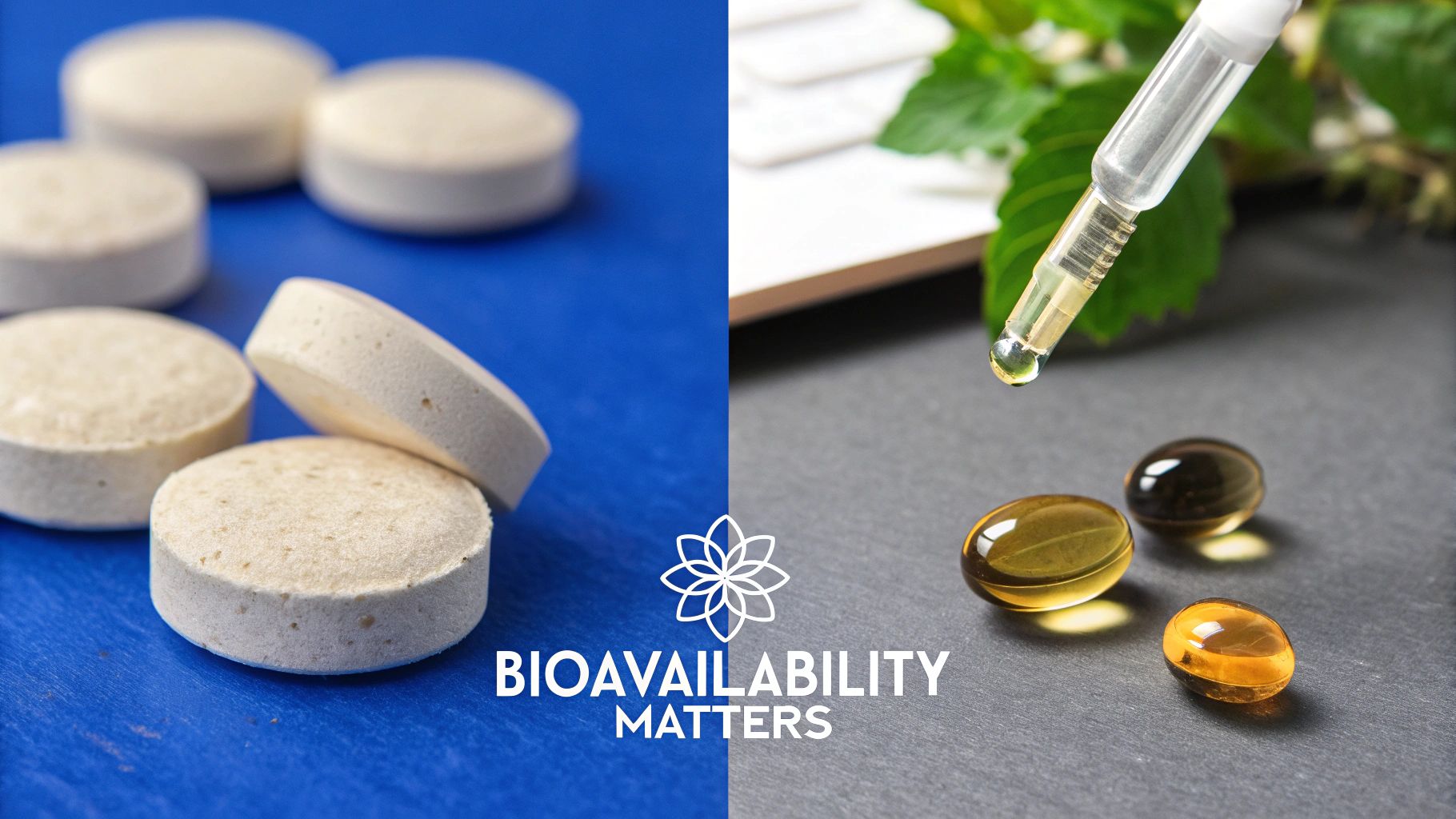
When choosing between tablets and liquid gels, two of the most important factors are bioavailability—how much of the active ingredient your customer's body can actually use—and formulation flexibility. These aren't just technical details; they directly impact your product’s effectiveness, the claims you can make, and ultimately, your brand's reputation. It’s about the science driving the results.
This is where your choice becomes a serious R&D decision. The goal is to perfectly match your active ingredients with the delivery system that unlocks their full potential.
The Bioavailability Debate: Faster vs. Smarter Absorption
Liquid gels have earned a reputation for superior bioavailability, and for good reason. Because the active ingredients are already pre-dissolved in a liquid or oil, the body gets a head start. It can skip the process of breaking down a solid tablet, which often means faster and more efficient absorption.
This is especially true for key types of compounds:
- Oil-Based Ingredients: Nutrients like fish oil (Omega-3s), Vitamin D, and Vitamin E are fat-soluble. Putting them in a liquid gel is the most direct and effective delivery method.
- Low-Solubility Compounds: Ingredients like Coenzyme Q10 (CoQ10) don't dissolve well in water. Suspending them in a lipid base inside a liquid gel can give their uptake a major boost.
- Low-Melting-Point Botanicals: Some delicate herbal extracts can't handle the heat and intense pressure of the tablet compression process. A liquid gel—especially using advanced cold-fill technology—offers a much gentler environment.
But don't count tablets out just yet. Modern tablet technology has come a long way. Major innovations in coatings and excipients have narrowed the bioavailability gap considerably.
Key Insight: The bioavailability conversation has evolved. It's no longer a simple "liquid is better" argument. Now, it’s a more nuanced discussion about pairing the right delivery technology with the specific ingredient for peak performance.
Today, specialized tablet coatings give us precise control over where an ingredient is released in the digestive tract. Enteric coatings, for example, act as a shield, protecting sensitive ingredients like probiotics from harsh stomach acid. This ensures they arrive in the intestines unharmed, right where they need to be. This kind of targeted delivery is a powerful tool not easily replicated in standard liquid gel formats.
Formulation Flexibility: Where Each Format Shines
Your product vision is a huge factor in which format makes the most sense. The ability to combine multiple ingredients, manage how they interact, and ensure the final product is stable is at the core of supplement development. This is where the differences between tablets and liquid gels become crystal clear.
Tablets: The Masters of Complexity
When it comes to creating complex, multi-ingredient formulas, tablets are the undisputed champions. The manufacturing process allows formulators to layer or blend ingredients that might otherwise be incompatible if mixed in a liquid.
Think about a comprehensive multivitamin. You can pack minerals, water-soluble vitamins, and powdered botanical extracts into a single, stable dose. That's a feat that would be nearly impossible in a liquid gel without running into major stability problems. For any brand aiming to create that all-in-one daily supplement, tablets provide unmatched versatility.
Liquid Gels: The Specialists for Oils and Sensitive Actives
Liquid gels dominate where tablets just can't compete: handling oils and lipids. They create a hermetically sealed, oxygen-free environment that's perfect for protecting sensitive oils from oxidation. This makes them the only logical choice for products like high-potency Omega-3 fish oil, krill oil, or Vitamin D3 suspended in olive oil.
The trade-off? Liquid gels are generally less suited for complex blends of powdered ingredients. Water-based ingredients can weaken the gelatin shell, and mixing different types of compounds can create stability and homogeneity challenges.
To get a better handle on these intricacies, our guide to nutraceutical formulation development offers a deeper look into creating stable and effective products. Partnering with an experienced manufacturer from the start is so valuable—we navigate these formulation hurdles before they become roadblocks to your launch.
Manufacturing Realities: Cost, Speed, and Scale
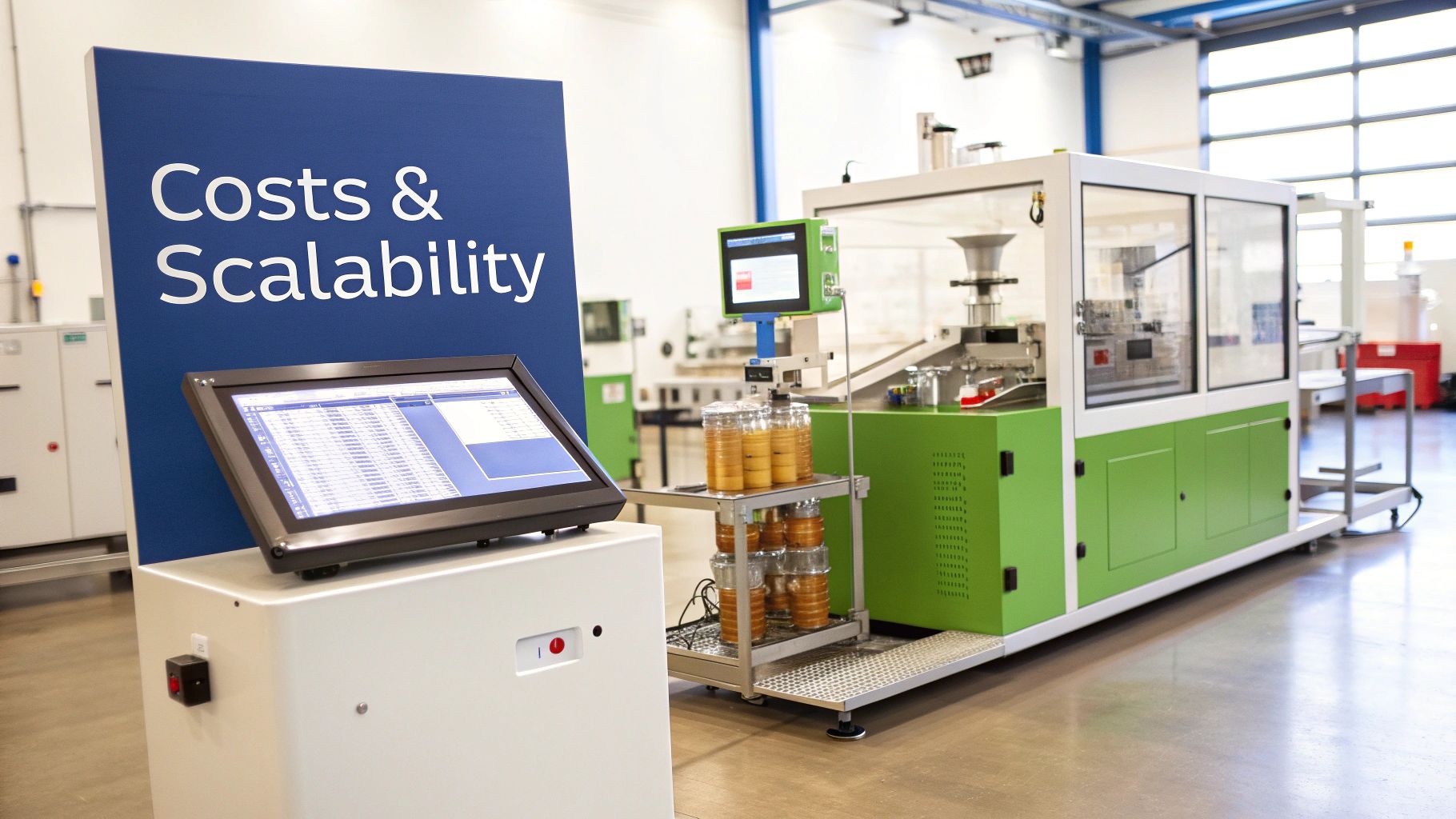
We've covered the science—bioavailability, formulation, and stability. Now we get to the part that directly impacts your bottom line: the practical realities of manufacturing and cost. This is where the tablet vs. liquid gel debate gets real, fast.
Making the right call here is about more than just the product; it's about budgeting for your launch, forecasting scalability, and defining your go-to-market timeline. Honestly, this is the stage where having a true manufacturing partner, not just a supplier, becomes non-negotiable.
As your R&D and production partner, our job is to pull back the curtain on these complexities. We provide the transparent, straightforward insights you need to make a choice that aligns with your business goals, not just your product idea.
The Tablet Advantage: Efficiency and Accessibility
Tablet manufacturing is a well-oiled machine. The process—a finely tuned sequence of blending, high-pressure compression, and sometimes coating—has been refined over decades. The result? An incredibly efficient and cost-effective system, which creates major advantages for brands.
That efficiency translates to rapid turnaround times. The equipment is standardized, the process is streamlined, and we move from raw ingredients to finished, bottled products with impressive speed and reliability.
Even better, this operational efficiency opens the door to lower minimum order quantities (MOQs). This is a game-changer for new brands or established companies testing a new formula. You can get to market with a smaller initial investment, see how customers react, and then scale up without sinking capital into inventory right off the bat. We offer the flexibility for both pilot and full-scale runs.
The Liquid Gel Commitment: Specialized and Precise
Making liquid gels is a different ballgame. It's an intricate, specialized process that relies on sophisticated machinery to form, fill, and hermetically seal the shells in one continuous, fluid motion.
This process is demanding. It requires a strictly controlled environment where temperature and humidity are meticulously managed in our cGMP, UL certified, and FDA-registered facility. The shells themselves are sensitive, so any fluctuation can compromise their integrity.
Key Insight: The choice between tablets and liquid gels is often a trade-off. You're weighing the proven efficiency of tablet compression against the specialized, high-control environment that liquid gel encapsulation demands. Your budget, timeline, and scale will point you in the right direction.
As you might guess, the initial setup and production costs for liquid gels are higher. The specialized equipment and need for stringent environmental controls lead to larger MOQs than tablets. While this means a bigger upfront commitment, it's a necessary investment to deliver the unique benefits of a liquid gel—especially for oil-based supplements where tablets simply aren't an option.
Cost Implications and What the Market Tells Us
When you put them side-by-side, tablets are almost always the more budget-friendly option on a per-unit basis. This cost advantage makes them a fantastic choice for products targeting a broad market or competing in a category where price is a major factor.
However, the higher manufacturing cost of liquid gels is often balanced out by the premium positioning they allow. Many consumers associate liquid gels with higher quality and faster action, which means you can often command a higher retail price to offset the increased production expense.
The market data backs this up. The softgel capsule market (which includes liquid gels) has shown steady growth, but it's still dwarfed by the massive tablet sector. Valued at roughly USD 1.21 billion, the global softgel market sees gelatin-based options holding over 60% of the share, mainly due to well-established and more cost-effective production methods. Understanding this context is crucial for figuring out where your product will fit in the broader supplement landscape.
Mastering Stability and Shelf Life
A product's journey doesn't end when it leaves our cGMP-certified facility; it’s just beginning. The real test is ensuring your supplement remains stable, safe, and effective until the moment your customer uses it. In the "tablets vs liquid gels" debate, this is where supply chain planning and packaging choices become critical.
The stability profile of each format directly impacts how your product must be handled, stored, and shipped. Getting this right is fundamental to protecting your brand’s reputation and ensuring customer satisfaction through on-time, intact delivery.
The Robust Nature of Tablets
Tablets are the workhorses of the supplement world for a reason. Their compressed, solid form makes them inherently robust and less susceptible to environmental stressors like heat and humidity. This resilience simplifies the supply chain significantly.
Tablets generally don't require specialized climate-controlled shipping or warehousing, which can lower your logistical costs. Their durability allows for straightforward, cost-effective packaging—typically in standard bottles—without much worry about degradation. This makes them a reliable choice for products distributed across wide geographic areas with varying climates.
Key Insight: The inherent stability of tablets translates directly into supply chain efficiency and reduced logistical complexity. This is a major advantage for brands prioritizing cost control and broad distribution.
However, their stability isn't absolute. While the structure is sound, certain active ingredients within the tablet can still be susceptible to slow degradation from oxygen exposure over time, especially after the bottle is opened.
The Sealed Protection of Liquid Gels
Liquid gels present a fascinating duality. The gelatin or plant-based shell is more sensitive to its environment than a solid tablet. High heat can cause them to soften or stick together, and excessive humidity can compromise the shell’s integrity. This requires more careful consideration during shipping and storage, particularly in warmer months or climates.
But inside that delicate shell lies a key advantage: a hermetically sealed environment. This airtight seal provides unmatched protection against oxidation for sensitive, oil-based ingredients. For formulations built around Omega-3s, Vitamin E, or CoQ10, a liquid gel isn't just an option—it's often a necessity to preserve potency.
This superior protection against oxidation is a primary driver behind their market growth. Softgel capsules currently hold a dominant 67.6% market share within the liquid-filled capsule segment, largely because of their proven stability for oils and suspensions. This market is projected to continue growing as brands seek to deliver sensitive ingredients in their most effective state.
How Stability Dictates Packaging and Handling
Your choice of format directly influences your packaging strategy and the associated costs. We offer full customization for both.
- For Tablets: Standard HDPE or PET bottles with simple desiccant packs are often sufficient. They are cost-effective, easy to source, and provide adequate protection.
- For Liquid Gels: Packaging may need to be more robust. Blister packs are a popular choice as they separate each capsule, preventing them from sticking together and providing an individual barrier against moisture and air. While more expensive than bottling, this ensures each dose remains pristine.
Ultimately, managing stability is a core component of your product's success. It's a technical challenge that requires a deep understanding of formulation science and manufacturing best practices. Our comprehensive approach to supplement quality control ensures that from raw ingredient testing to final packaging and third-party validation, your product’s integrity is protected every step of the way. As your manufacturing partner, we help you navigate these choices to ensure your product maintains its quality from our facility all the way to your customer's shelf.
Crafting Your Market Position and Brand Story
Long before a customer ever reads your label, the form of your supplement—tablet or liquid gel—has already started telling them a story. This choice isn't just about formulation; it's one of the most fundamental branding decisions you'll make. It anchors your brand’s identity and sets the stage for everything from packaging and price point to the marketing claims you can make with confidence.
In the consumer’s mind, tablets have a long-standing reputation. They feel traditional, reliable, and straightforward. This perception makes them a natural fit for daily essentials like a comprehensive multivitamin or a foundational mineral complex. They’re perfect for a broad, value-conscious audience where the brand story is all about dependability and accessibility.
Aligning Format with Consumer Perception
On the other hand, liquid gels, with their sleek, often translucent appearance, project a much more modern and premium image. They’re immediately associated with advanced science and rapid action.
This makes them the obvious choice for high-impact, specialized formulas. Think of a potent Omega-3, a highly bioavailable CoQ10, or a cutting-edge botanical extract. This format is practically designed for a discerning customer who is willing to pay more for benefits like faster absorption and superior quality. Your brand story instantly shifts from everyday wellness to targeted, high-performance results.
Key Insight: Your delivery format is a core part of your product's narrative. A tablet says, "I'm a reliable daily staple." A liquid gel often communicates, "I'm a premium, fast-acting solution." Use this built-in perception to your advantage.
Building Your Brand Narrative
How you use this perception is the key to building a brand that sticks. The story you tell needs to be consistent at every touchpoint, and the physical form of your product is the very first chapter.
Let's look at two distinct brand approaches:
- The "Everyday Essentials" Brand: This brand builds its foundation on tablets. Its messaging centers on trust, consistency, and affordability. The packaging is clean, simple, and functional, reinforcing the idea of a no-nonsense, reliable supplement for the whole family.
- The "Bio-Optimized Performance" Brand: This brand deals exclusively in liquid gels. Its marketing is packed with terms like "scientific innovation," "purity," and "enhanced bioavailability." The packaging is sophisticated and minimalist, designed to attract a customer who researches ingredients and prioritizes peak performance.
Both strategies are completely valid, but they speak to fundamentally different people. Your decision between tablets and liquid gels is the first real step in defining which path your brand will follow. To see how other brands effectively connect with their audience, it’s worth exploring some powerful business storytelling examples that build a loyal following.
Ultimately, the goal is to create a seamless link between your product's form, its function, and the story you want to tell. As your R&D and manufacturing partner, we help you align these critical elements, ensuring your product not only works well but also communicates its value clearly from the moment a customer sees it.
Your Decision Framework: Choosing the Right Path
After breaking down bioavailability, manufacturing costs, stability, and brand positioning, it's time to pull it all together. The choice between tablets and liquid gels is a strategic move that needs to align with your specific formula, target audience, and business goals. There’s no single right answer, only the optimal path for your brand’s unique story.
This framework is designed to help you cut through the noise. By working through these key points, you can move past the guesswork and land on the format that gives your product the best shot at success.
This decision tree shows how your brand story—whether you're targeting a broad audience, a premium niche, or emphasizing fast action—can steer your choice between tablets and liquid gels.
As you can see, tablets often serve as the foundation for brands aiming for mass appeal, while liquid gels are the go-to for premium or fast-acting product lines that command a higher price point.
Key Strategic Questions
To solidify your direction, let’s dig into the three core pillars of your product strategy. Your answers here will almost certainly point you toward either tablets or liquid gels.
1. What Are Your Primary Active Ingredients? If your formula is a complex mix of dry powders, minerals, or botanicals, tablets are your workhorse. They offer unmatched versatility and stability, making them the perfect choice for comprehensive multivitamins or multi-herb blends. But if your star ingredient is an oil (like Omega-3s), a fat-soluble vitamin (like D3 or E), or a compound with a low melting point (like CoQ10), a liquid gel is hands-down the superior option. In many cases, it’s the only way to ensure both stability and bioavailability.
2. Who Is Your Target Customer and How Is Your Brand Positioned? Are you launching a cost-effective daily essential for a wide audience? Tablets fit perfectly with a brand story centered on reliability, accessibility, and value. On the flip side, if you're building a premium brand for discerning consumers who want rapid absorption and the latest science, liquid gels project that modern, high-performance image. That perception helps justify a higher price and will resonate much better with that market.
Your Final Checkpoint: If cost-efficiency and handling complex dry formulas are your top priorities, tablets are your go-to. If premium positioning and delivering oil-based nutrients are paramount, liquid gels are the clear winner.
3. What Are Your Business and Launch Goals? For a new brand testing the waters or launching on a tight budget, the lower MOQs and per-unit cost of tablets offer a much more accessible entry point. Our flexibility in run sizes gives you the ability to validate your product in the market before scaling up. However, if your launch is well-funded and you're aiming to capture a premium segment from day one, the higher initial investment for liquid gels is a strategic move that immediately establishes your brand’s quality credentials.
Decision Matrix: Tablets vs. Liquid Gels
This simple matrix is designed to give you a final, at-a-glance gut check. Run your product concept through these criteria to see where you land.
| Consideration | Choose Tablets If... | Choose Liquid Gels If... |
|---|---|---|
| Active Ingredients | Your formula is a complex blend of dry powders, herbs, or minerals. | Your key ingredient is an oil, fat-soluble vitamin, or has a low melting point. |
| Brand Positioning | You're aiming for mass-market appeal, value, and accessibility. | You're building a premium, high-performance, or science-forward brand. |
| Bioavailability | Your ingredients are water-soluble and don't require enhanced absorption. | You need to maximize the absorption of fat-soluble or poorly soluble nutrients. |
| Budget & MOQ | You need a lower cost of entry and smaller initial production runs. | You have the budget for a higher initial investment and can meet larger MOQs. |
| Target Customer | Your customer is practical, budget-conscious, and values convenience. | Your customer prioritizes rapid results, premium quality, and is willing to pay more. |
| Formula Stability | You need a highly stable format for moisture-sensitive ingredients. | You need to protect oxygen-sensitive oils or liquids from degradation. |
Ultimately, this table reinforces the core idea: your choice depends entirely on your strategy. Neither format is inherently "better"—it's about which one is better for you.
Partnering for Success From Concept to Launch
Making this decision is a critical first step, but it’s just the beginning. Turning your idea into a market-ready, compliant, and successful product requires deep expertise in formulation, manufacturing, and quality control. At Triton Nutra Group, we act as an extension of your team—your dedicated R&D partner—to guide you through every stage.
Whether you've landed on tablets or are leaning toward the unique advantages of liquid gels, our team is ready to help you build a best-in-class supplement. We bring our cGMP, UL certified, and FDA-registered processes and a true partnership mindset to the table to make sure your vision becomes a reality.
Ready to take the next step? Let's talk about your product idea. Contact us today for a consultation and discover how we can help you launch with confidence.
Common Questions From Brands Like Yours
As you get closer to a decision, a few practical questions always pop up. Let's tackle them head-on, drawing from our experience helping hundreds of brands navigate this exact choice.
Can We Really Make Tablets Fast-Absorbing?
Absolutely. It’s a common myth that you have to sacrifice speed if you choose a tablet. While liquid gels have a natural head start since their payload is already dissolved, modern tableting technology has come a long way. We're not just pressing powders anymore.
We use innovative methods to accelerate absorption:
- Rapid-Disintegrating Tech: We use specific, smart excipients (inactive ingredients) that cause the tablet to break apart almost immediately in the stomach.
- Micronization: We can physically reduce the particle size of your active ingredients. Smaller particles mean a much larger surface area, which translates directly to dissolving faster once they're released.
So while a liquid gel might always have a slight edge for oils, a well-formulated tablet can be highly competitive on absorption speed. It’s definitely not the deal-breaker it used to be.
What About Vegan Options for Liquid Gels?
Yes, and thankfully, they're excellent now. For a long time, gelatin—which is animal-based—was the only real option, shutting out the vegan market. That's not the case anymore.
The demand for plant-based supplements has pushed innovation forward. We now have fantastic vegan shells made from ingredients like tapioca or seaweed derivatives (carrageenan). They perform just as well as gelatin, offering the same sealed protection for sensitive oils against oxygen, but they align perfectly with a vegan or plant-based brand promise. We can help you customize the formula to ensure the final product is exactly what your customers are looking for.
How Do MOQs Affect a New Product Launch?
This is one of the most critical business considerations, especially for a startup or a brand testing a new product line. Minimum Order Quantities (MOQs) can make or break a launch budget.
Here’s the straightforward reality: tablets almost always have significantly lower MOQs. The machinery and setup are just simpler and more efficient for smaller runs. This makes them the perfect starting point for testing the market without a massive upfront investment.
Liquid gel encapsulation, on the other hand, is a more complex process. The equipment is specialized and the setup is more intensive, which naturally pushes the MOQs higher. But at Triton Nutra Group, we don't believe in a one-size-fits-all approach. We’ve built our business on being flexible partners, working with brands to find creative solutions, whether you're launching a small pilot batch or gearing up for a full-scale release.
Ready to turn your supplement vision into a market-ready success? The experts at Triton Nutra Group are here to guide you through every step, from formulation to fulfillment. Request a free consultation today
