Powder Supplements Manufacturing: A Practical Guide to Launching Your Brand
powder supplements manufacturing explained: formulation, quality, cGMP, sourcing, and how to find the right partner to launch your brand.
 Get a Free Quote Today!
Powder supplements are a game-changer. They offer a flexibility you just can't get with pills or capsules, letting you deliver high doses of powerful ingredients like protein, collagen, and greens. The process itself is a multi-step journey: sourcing raw ingredients, nailing down the perfect formula, blending everything just right, and finally, packaging it all up in a facility that meets strict cGMP standards.
Launching Your Powder Supplement Brand
So, you've got a killer idea for a powder supplement. Awesome. But turning that idea into a product on a shelf (or in a customer's cart) can feel like navigating a maze. This guide is your map. We're going to break down the entire powder supplements manufacturing process, giving you a clear, step-by-step playbook to launch your brand with total confidence. Forget the dry, textbook stuff—this is the insider’s guide.
Think of us as your R&D partner from concept through launch. We'll walk you through everything, with a relentless focus on quality, speed, and reliability. This journey has several key stages, and the decisions you make at each one will shape your product and build your brand's reputation for years to come.
Understanding the Market Opportunity
Let's be clear: the demand for high-quality powder supplements isn't just growing, it's exploding. Projections show the global powder dietary supplements market rocketing from USD 43.9 billion in 2025 to a massive USD 97.1 billion by 2035. That's a compound annual growth rate (CAGR) of 8.3%.
What's driving this? A massive cultural shift towards health awareness and preventive care. This creates a huge opening for innovative brands to enter the space. The market is competitive, sure, but a well-made, high-quality product backed by a solid manufacturing partner has a very real shot at success. It all comes down to making smart choices from day one.
The Core Pillars of a Successful Launch
Bringing a powder supplement to market is about more than just a good recipe. You need a strategic plan built on the bedrock of quality and compliance. To get it right, you need to nail these four essential pillars:
- Formula Development: This is where your vision becomes a reality. It's about creating a product that's stable, effective, tastes amazing, and solves a real problem for your customers.
- Raw Material Sourcing: Every single ingredient has to be pure, potent, and traceable. We work only with vetted suppliers who meet our rigorous quality standards.
- cGMP Compliance: This is non-negotiable. Your product must be made in an FDA-registered, UL-certified facility that follows Current Good Manufacturing Practices, guaranteeing it's produced safely and consistently every single time.
- Strategic Partnership: Your choice of a manufacturer is critical. You don't just want a supplier; you want a collaborator who offers flexible order sizes, from pilot to full-scale, transparent timelines, and the know-how to help you scale.
Your manufacturing partner is the most important decision you'll make. They are not just a supplier; they are the operational backbone of your brand, responsible for the quality and integrity of every unit you sell.
As you plan your launch, don't forget the outside of the container. A great private label packaging setup is crucial for making your product stand out. In the end, your success rides on a partnership that puts quality, reliability, and a shared vision for growth first.
How Your Supplement Goes From Formula To Finished Product
Let's pull back the curtain on the meticulous journey your powder supplement takes inside a cGMP-certified facility. This isn’t just about tossing ingredients into a big vat; it's a precise, multi-stage process where quality is embedded at every single turn. Think of it less like a simple recipe and more like a carefully choreographed production where every step is documented, verified, and executed flawlessly.
The entire process actually kicks off long before any powders get blended. It starts with your vision. Our job as your manufacturing partner is to translate that vision into a viable, stable, and great-tasting product that people will love. This initial phase is all about transforming a concept into a precise, repeatable recipe, complete with exact ingredient dosages and flavor profiles.
This visual roadmap gives you a high-level look at the journey, from that first spark of an idea to a product that's ready for your customers.
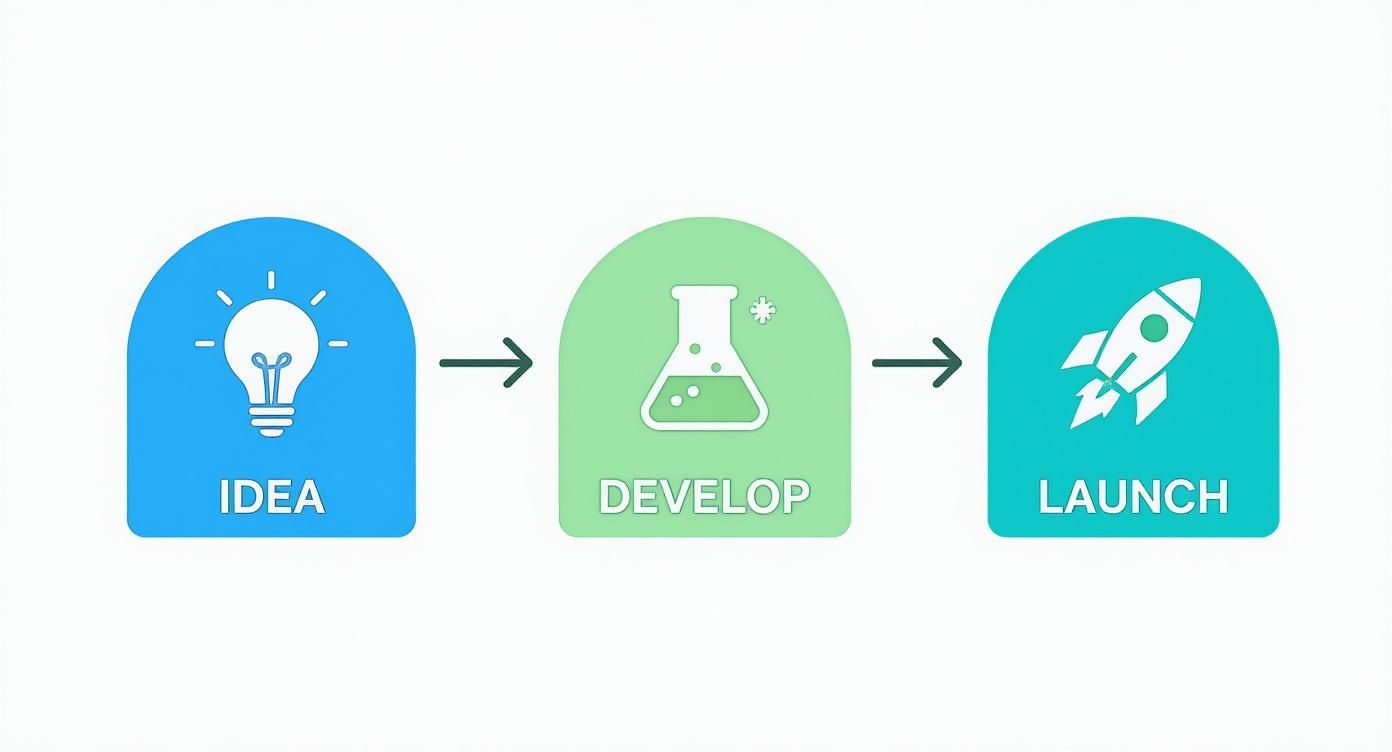
Each of these stages—Idea, Develop, and Launch—represents a critical phase that demands deep collaboration and expertise to get right.
The Blueprint: R&D And Formulation
The formulation stage is where the science behind your product meets the promise you make to your customers. It involves so much more than just slapping a list of ingredients together. We meticulously balance the active components with excipients (the unsung heroes that help with powder flow and stability), sweeteners, and flavor systems to create a final product that's both effective and enjoyable to use.
Our team will work side-by-side with you to dial in every last detail. This hands-on approach ensures the final formula not only hits your efficacy goals but also aligns with your target cost-per-unit. If you're still sketching things out, our guide on how to create a supplement formula is a great place to build your foundation.
Partnership Insight: A great manufacturer doesn't just take orders. They function as an extension of your R&D team, asking crucial questions like, "How can we improve the mouthfeel?" or "Is there a more bioavailable form of this nutrient we should be using?"
Precision On The Production Floor
Once the formula is locked in and all raw materials have been sourced and verified, the real magic begins. From here, the process flows through a series of controlled mechanical steps, each one designed to guarantee consistency and quality from the first scoop to the last. Operating within an FDA-registered facility means every single one of these steps is governed by strict, non-negotiable protocols.
This is where your product truly takes shape. Each stage is a critical checkpoint that builds on the last, all leading to a finished good you can be proud to put your name on.
The table below breaks down these core stages and shows where quality control comes into play at every step. It’s this obsessive attention to detail that separates a good product from a great one.
Powder Manufacturing Stages and Quality Checkpoints
| Manufacturing Stage | Key Action | Critical Quality Checkpoint |
|---|---|---|
| 1. Raw Material Receiving & Quarantine | All incoming ingredients are received, cataloged, and placed in a quarantined area. | Identity, purity, and potency testing on every ingredient via FTIR and other lab methods before release. |
| 2. Precision Weighing & Staging | Each ingredient is weighed to the exact gram on calibrated scales, as per the master formula. | Double-verification of weights and lot numbers by a second technician to prevent any errors. |
| 3. Blending | Ingredients are loaded into large-scale V-blenders or ribbon blenders for a set time and speed. | In-process blend uniformity testing to ensure perfect homogeneity from top to bottom. |
| 4. Milling / Granulation (If Needed) | Powder is passed through milling equipment to achieve a uniform particle size for better mixability. | Particle size analysis to confirm the powder meets solubility and flow specifications. |
| 5. Filling & Packaging | The finished powder is dosed into final packaging (tubs, jars, stick packs) via an automated line. | Continuous fill weight checks to ensure every container has the precise amount of product promised on the label. |
| 6. Finished Product Testing | Final packaged units are sampled and sent for final third-party lab analysis. | Confirms label claims for potency and screens for heavy metals, microbes, and other contaminants. |
As you can see, our quality control team is performing checks all the way through the process. They monitor everything from blend uniformity to fill weight accuracy, making sure the product that leaves our facility is exactly what you envisioned and precisely what your label promises. This unwavering commitment to compliance and quality gives you—and your customers—complete confidence in your brand.
Sourcing Raw Materials for Quality and Efficacy
Let’s be blunt: your supplement is only as good as the ingredients you put into it. It’s like trying to cook a five-star meal—even the best chef in the world can't work magic with old, subpar ingredients. When it comes to powder supplements manufacturing, sourcing is where the promise of quality, safety, and effectiveness truly begins.
A top-tier manufacturing partner doesn’t just place orders for ingredients; they cultivate a deeply vetted global network of suppliers. This supply chain integrity is your first and most important line of defense. It ensures every batch of your product is just as potent and pure as the last. Every supplier has to meet strict quality standards, backed by piles of documentation and a proven history of reliability.
This obsessive attention to detail right from the start lays a foundation of excellence for the entire manufacturing journey.
Understanding Ingredient Forms and Why They Matter
Here’s a detail that often separates the pros from the amateurs: not all ingredients are created equal, even if they have the same name on the label. The specific form of an ingredient can massively change how well your body absorbs it (bioavailability), what it actually does, and even how it tastes in the final blend.
Take whey protein, a classic in the sports nutrition space. The choice between its different forms has huge implications for who your product is for and how you market it.
- Whey Protein Concentrate (WPC): This form usually contains 70-80% protein, along with some naturally occurring fats and lactose. It's a fantastic, cost-effective choice for a general-use protein powder.
- Whey Protein Isolate (WPI): WPI goes through extra processing to strip out most of the fats and lactose, pushing the protein content to over 90%. This makes it the perfect pick for customers who are lactose intolerant or want the leanest possible protein source.
This same logic applies across the board—to vitamins, minerals, and botanical extracts. An experienced manufacturer will be your guide, helping you select the perfect form to hit your product goals while balancing efficacy and cost.
Every single raw material that enters our facility is immediately placed into quarantine. It's not released for production until our in-house lab verifies its identity, purity, and potency against the supplier's documentation. This is a non-negotiable step in our quality promise.
The Certificate of Analysis: A Non-Negotiable Checkpoint
For every single batch of every raw material, a Certificate of Analysis (CoA) is non-negotiable. Think of the CoA as a passport for that ingredient. The supplier provides it to verify all the important specs—confirming that the material meets the required standards for identity, purity, and potency. It also shows it's been tested for nasty stuff like heavy metals and microbes.
But a truly trustworthy manufacturer doesn’t just take the supplier’s word for it. They go a step further, running their own in-house and third-party lab tests to confirm everything on the CoA. This double-check creates an unbreakable chain of trust and transparency, guaranteeing that what’s supposed to be in your product is exactly what's in it. And nothing else.
Meeting the Demand for Specialized Ingredients
Today’s customers are savvy. They aren't just buying a product; they're buying into a lifestyle, and they actively look for supplements that align with their dietary needs and personal values. Catering to these preferences isn’t a niche request anymore—it's a mainstream expectation that can make or break your brand.
The global protein powder market alone, a giant slice of the powder manufacturing world, was valued at USD 24.6 billion in 2024 and is expected to rocket to USD 46.2 billion by 2034. A huge driver for this growth is the surging demand for plant-based options, which is pushing manufacturers to innovate on flavor and nutrition for vegan proteins. You can dive deeper into these market trends in this detailed industry analysis.
This trend goes well beyond just vegan options. Some of the most common requests we see from brand owners include:
- Non-GMO: Using ingredients from sources that have not been genetically modified.
- Organic: Sourcing from certified organic farms that avoid prohibited pesticides and fertilizers.
- Allergen-Free: Formulating without common allergens like gluten, soy, and dairy.
Opting for these specialized ingredients often changes the entire manufacturing process, from which suppliers we use to how we clean the equipment between runs. As your partner, we have the established supply chains and operational know-how to build these attributes into your product line seamlessly, so you can confidently meet customer demand without ever compromising on quality.
Understanding cGMP Rules and FDA Compliance
Getting a handle on the regulatory landscape is easily the single most important part of building a supplement brand that lasts. This isn't just about checking boxes off a list; it’s the very foundation of your brand's reputation and credibility. For anyone getting into powder supplements manufacturing, understanding the rules isn’t just a good idea—it’s your license to operate.
Think of it like the foundation of a house. If that foundation is cracked or poorly built, anything you put on top is at risk of crumbling down the line. We're going to demystify the key regulations here, breaking down what they actually mean for your product in practical, easy-to-understand terms.
Demystifying Current Good Manufacturing Practices (cGMP)
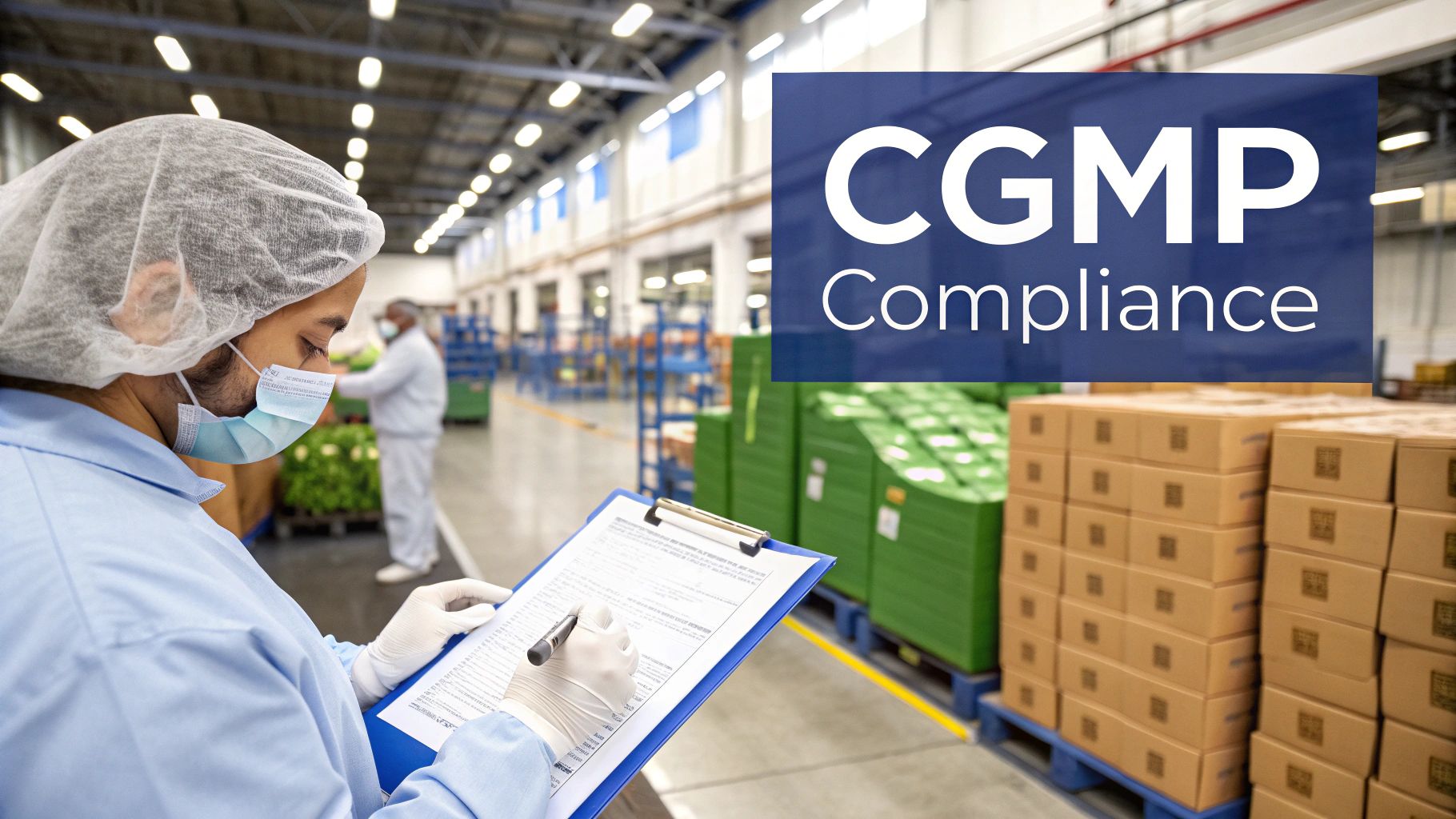
The term Current Good Manufacturing Practices (cGMP) might sound intimidating, but the core idea is pretty straightforward. It’s a set of rules enforced by the FDA to ensure your supplement is produced safely and consistently, batch after batch. It’s the official system for making sure what's on your label is exactly what's in the tub, and that it was made in a clean, controlled environment.
You can tell a lot about a manufacturer by their commitment to cGMP. It's not a one-and-done certificate you hang on the wall; it's a living, breathing process that dictates everything happening on the production floor.
- Meticulous Documentation: Every single step, from weighing raw materials to the final seal on the package, is logged in a master batch record. This creates an ironclad paper trail, ensuring total accountability.
- Equipment Sanitation: All machinery—blenders, mills, fillers, you name it—must be cleaned and sanitized using strict, validated procedures to prevent even the slightest chance of cross-contamination.
- Employee Training: Every team member is thoroughly trained on hygiene protocols, their specific job, and the core principles of cGMP. This ensures everyone is on the same page, upholding the same high standards.
Think of cGMP as the operational blueprint for quality. It demands that every process is defined, controlled, and documented, leaving zero room for guesswork or inconsistency. This is how a great manufacturer guarantees that batch #100 is identical in quality to batch #1.
The Role of the FDA and Third-Party Audits
Here’s a common misconception: people often think the FDA "approves" dietary supplements before they hit the market. That's not how it works. Instead, the FDA sets the rules (the cGMPs we just talked about) and then conducts inspections of manufacturing facilities to make sure they're being followed.
This means a manufacturer must be FDA-registered, which is really just them telling the agency, "Hey, we're here, and this is where we make supplements." The real test comes during unannounced FDA inspections, where an agent can show up and audit everything from sanitation logs to employee training records.
Because you can’t wait around for an FDA inspection to know if your partner is up to snuff, top-tier manufacturers voluntarily seek out third-party certifications. They invite independent bodies like UL or NSF International to conduct their own rigorous audits, which are often even more demanding than the FDA's. This certification acts as an independent seal of approval, giving you—and your customers—verifiable proof of a manufacturer’s commitment to excellence. For a deeper dive, check out this guide to the essential dietary supplement manufacturing requirements.
Nailing Your FDA-Compliant Label
Your product’s label is more than just marketing; it’s a legal document. It's your direct line of communication to your customer and to regulators, so getting it right is completely non-negotiable. An FDA-compliant label isn’t about flashy design; it’s about presenting very specific information in a standardized format.
Here are the absolute must-haves for every compliant supplement label:
- Statement of Identity: The common name of your supplement (e.g., "Whey Protein Powder").
- Net Quantity of Contents: How much product is inside (e.g., "Net Wt. 2 lbs (907g)").
- Supplement Facts Panel: The standardized box listing serving size, servings per container, and all dietary ingredients with their amounts and % Daily Value.
- Ingredient List: A list of all ingredients in descending order by weight.
- Name and Place of Business: The name and address of the manufacturer, packer, or distributor.
Most importantly, you have to be incredibly careful about the claims you make. You are allowed to make "structure/function" claims (like "supports a healthy immune system"), but you are strictly forbidden from claiming your product will diagnose, treat, cure, or prevent any disease (like "prevents the flu"). This is a fine line to walk, and partnering with a manufacturer who lives and breathes these rules is crucial for keeping your brand safe and successful.
Scaling Production From Pilot Batches To Full Runs
As your brand starts to catch fire, your manufacturing needs are going to change. The partner who helped you get off the ground needs to be the same one who can help you soar, making the leap from initial test batches to massive commercial orders feel seamless. This is where the logistics of production volume get real, and a manufacturer’s flexibility (or lack thereof) can make or break your momentum.
Thinking about volume starts with one key acronym: MOQ, or Minimum Order Quantity. This is the smallest number of units a manufacturer will agree to produce in a single run. Why do they exist? Simple economics. Every run has fixed costs for setting up machines, deep cleaning, labor, and quality control. A flexible partner gets this and offers MOQs that grow with you, supporting your brand whether you're a scrappy startup or an established market leader.
The Strategic Value of a Pilot Batch
Before you go all-in on an order for ten thousand units, it’s incredibly smart to start small. A pilot batch is a smaller, trial-sized production run, usually somewhere between a few hundred to a couple of thousand units.
Think of it as a dress rehearsal for your big launch. It’s one of the most valuable tools you have for dodging risks and perfecting your product before you sink major capital into inventory.
Starting with a pilot batch gives you some serious advantages:
- Flavor and Formula Validation: This is your chance to get real-world feedback on taste, texture, and mixability from an actual test group. It's how you ensure your product is a hit right out of the gate.
- Market Testing: You can launch with a smaller, more manageable inventory to see how the market reacts. Test your marketing messages, prove your concept, and do it all without tying up a huge amount of cash.
- Stability Trials: A pilot batch gives you the physical units you need to run real-time stability tests, confirming your product’s shelf life and making sure it holds up over time.
A pilot batch is your insurance policy against expensive mistakes. It lets you validate your formula and find your market fit on a small scale, giving you the data and confidence to invest in a full production run with minimal risk.
From Pilot To Full-Scale Production
Once your pilot batch is a proven winner, it's time to scale up. This is where you transition that validated formula from a small, R&D-sized blender to massive commercial blenders that can pump out tens of thousands of units at once. The real challenge? Maintaining perfect consistency.
The flavor profile, particle size, and nutrient distribution have to be identical whether you’re making 500 units or 50,000.
This is where a true partnership mindset really shines. A reliable manufacturer will have documented, repeatable processes to ensure this transition is flawless. We support your growth with transparent timelines and an on-time delivery record you can build your business on, ensuring you can meet rising customer demand without a single hiccup.
The global appetite for powder supplements is complex, with huge differences from one region to the next. For instance, while North America is still the biggest market, the Asia Pacific region is seeing explosive growth, with a forecasted CAGR of around 12.3%. This boom is driven by a massive, health-conscious population with a strong preference for herbal and immune-boosting supplements. Understanding these kinds of dynamics can shape your long-term scaling strategy. You can dig into more of these regional trends in this detailed market report from Grand View Research.
Ultimately, your manufacturer should be more than a vendor—they should be a collaborator who is genuinely invested in your success. They need to give you the flexibility to start small, the technical chops to scale flawlessly, and the rock-solid reliability to keep your supply chain humming as your brand takes over its corner of the market.
How To Choose The Right Manufacturing Partner
Let's be blunt: Picking your manufacturer is the single most important decision you'll make for your supplement brand. This isn't just about finding someone to mix powders in a big machine. It's about finding a strategic partner who will make or break your product's quality, your brand's reputation, and your ability to scale.
A true partner acts like an extension of your own team—they're just as invested in your success as you are. To find that perfect fit in the world of powder supplements manufacturing, you need to dig deeper than the glossy brochures. Your vetting process should be a forensic investigation into their capabilities, compliance, and how they operate. The goal is to make sure their entire business is built to support your vision, from that first small test batch to your hundred-thousandth unit.
Your Vetting Checklist for a Manufacturing Partner
Don't just wing these initial conversations. You need to walk in with a clear set of questions that will expose a potential partner's real strengths and weaknesses. Any manufacturer worth their salt will welcome this level of scrutiny and have clear, documented answers ready.
We recommend structuring your questions around three core areas:
- Quality and Compliance: The absolute non-negotiables. This is what protects your brand and, more importantly, your customers.
- Customization and Flexibility: Can they actually create the product you envision and grow with you?
- Speed and Reliability: The operational nuts and bolts that determine if your business runs smoothly or is constantly putting out fires.
Key Questions To Ask a Potential Partner
Use this checklist as your script for those first calls. The way they answer—or don't answer—will tell you everything you need to know about what it's like to work with them.
Quality & Compliance:
- Are you cGMP certified and FDA-registered? (This is table stakes, not a bonus.)
- Can I see your most recent third-party audit results from an organization like UL or NSF?
- What are your in-house testing protocols for raw ingredients when they arrive and for the final product before it ships?
- How do you guarantee traceability for every single ingredient in a batch?
Customization & Flexibility:
- What are your capabilities for custom formulation and flavor development? Do you have an in-house team for this?
- What are your Minimum Order Quantities (MOQs) for a brand-new product?
- As my brand grows, how do your run sizes scale? Can you handle a small pilot run now and a massive production run later?
- What packaging options do you offer? Tubs, stick packs, gusset bags?
Speed & Reliability:
- What's your average lead time, from the moment I sign a purchase order to the day the product ships?
- How do you communicate with clients about production timelines and, more importantly, potential delays?
- Can you put me in touch with a few other brands that have scaled with you?
- What is your on-time delivery record over the last year?
Choosing a manufacturer is about finding a collaborative ally who is as obsessed with quality as you are. Their willingness to be transparent about their processes, certifications, and timelines is a direct reflection of the kind of partner they will be.
Ultimately, you aren't just looking for a vendor—you need an R&D and operations partner rolled into one. For a deeper dive into this critical step, our detailed article offers key considerations for finding a reputable supplement manufacturer to help you make the smartest choice. This vetting process isn't just a formality; it's how you find a partner who won't just produce your supplement, but will help you build a business that lasts.
Answering Your Top Manufacturing Questions
When you're launching your first supplement, the manufacturing world can feel like a maze of technical questions. To help you find your way, we've put together some quick, no-nonsense answers to the questions we hear most often from founders just like you.
Think of this as your cheat sheet for the essentials. We'll skip the industry jargon and get straight to the point, giving you the clarity you need to make smart, confident moves for your brand.
What Is The Biggest Challenge In Powder Manufacturing?
Hands down, the single biggest hurdle is taste. You can have the most groundbreaking formula backed by solid science, but if your product tastes bad, you won't get repeat customers. It's that simple. First impressions are everything, and for a powder supplement, flavor is that first impression.
This is where an experienced manufacturing partner with a dedicated flavor team becomes non-negotiable. They've spent years mastering the art of balancing active ingredients, masking those tricky off-notes from vitamins or plant extracts, and creating a flavor profile that people actually enjoy drinking. That’s what drives customer loyalty.
Are Powdered Supplements Better Than Capsules?
It’s less about one being "better" and more about which one is right for the job. The real difference comes down to dosage. Powders are the perfect vehicle for ingredients that you need in large, gram-level doses—think about the 20+ grams of protein in a typical post-workout shake. Trying to get that same amount from capsules is completely impractical; you'd have to swallow a handful of pills.
Key Takeaway: For high-dosage ingredients like proteins, collagens, and greens powders, powders are the clear winner for convenience and practicality. For potent, low-dose micronutrients, capsules and tablets are often a more efficient choice.
What Certifications Should I Look For?
A manufacturer's certifications are a direct reflection of their commitment to quality and safety. At the absolute minimum, you should only consider partners who can show you proof of these two credentials:
- cGMP Certification: This is the baseline for quality in our industry. It confirms the manufacturer follows the FDA’s Current Good Manufacturing Practices. Don't just take their word for it—look for third-party verification from respected bodies like NSF or UL.
- FDA-Registered Facility: This simply means the manufacturer is on the FDA's radar and is subject to their inspections. It's a fundamental requirement.
Depending on your target market, other certifications can add significant value and open up new customer segments. Credentials like Certified Organic, Kosher, or Halal can build even greater trust and give your brand a competitive edge.
Ready to turn your vision for a market-leading supplement into a reality? The experts at Triton Nutra Group are your dedicated partners from concept to launch, offering unparalleled quality, flexibility, and speed. Start your project today and let's build your brand together.
