
A Private-Label Guide: Choosing Between Liquid vs. Pill Vitamins
Deciding between liquid vs pill vitamin formats? This guide compares bioavailability, manufacturing, and costs to help private-label brands succeed.
 Get a Free Quote Today!
As a brand manager or e-commerce founder, deciding between liquid vs. pill vitamins for your private-label supplement line is a critical strategic decision. This isn't just about a delivery format; it's about defining your target audience, your brand promise, and your entire operational model.
Liquids capture attention with claims of faster absorption and customizable dosing—ideal for niche, high-performance markets. Pills, in contrast, remain the undisputed champions of convenience, stability, and cost-effective scaling, making them perfect for a mass-market strategy. This guide is designed to give you, the entrepreneur, the insider’s perspective needed to make the right call for your brand’s success.
Choosing Your Supplement Format: A Strategic Decision
For health and wellness entrepreneurs, the liquid vs. pill debate is a foundational choice that impacts every aspect of your business. It dictates your formulation, manufacturing process, packaging, supply chain, and the marketing claims you can confidently make. Ultimately, it shapes your customer's entire experience with your brand.
The market is clearly signaling a shift. Global demand for liquid dietary supplements is surging, driven by consumers who prioritize efficacy and ease of use. One comprehensive report on liquid vitamins valued the market at USD 25.9 billion, with forecasts projecting it to reach USD 43.8 billion by 2034. This trend presents a significant opportunity for brands that can master the liquid format.
As your R&D partner from concept through launch, we know this isn't just about picking a format. It’s about aligning your product with a specific market need, whether that’s the precision of a liquid dropper for a pediatric line or the grab-and-go convenience of a capsule for busy professionals.
To help you navigate this critical decision, let's start with a high-level overview. For a deeper dive into the specific benefits and manufacturing of liquids, see our guide on what makes liquid supplements a powerful choice.
Quick Comparison for Private-Label Brands
Before we get into the nitty-gritty, this table offers a quick snapshot of the key differences. Think of it as a cheat sheet to help you quickly grasp the strategic implications of each format for your brand.
| Decision Factor | Liquid Vitamins | Pill Vitamins (Tablets/Capsules) |
|---|---|---|
| Target Audience Appeal | Perfect for kids, seniors, and anyone with "pill fatigue" or swallowing issues. | The go-to for busy consumers who value convenience and portability above all. |
| Dosing Flexibility | High. Allows for precise, customized dosing with droppers or measuring caps. | Low. The dosage is fixed per tablet or capsule, making adjustments difficult. |
| Manufacturing Complexity | More involved. Requires advanced flavor masking, preservation, and stability management. | Simpler and more standardized processes for blending, compression, and encapsulation. |
| Per-Unit Cost | Generally higher due to specialized bottling, heavier shipping, and formulation needs. | Lower and more cost-effective, especially when you scale, due to efficient production. |
As you can see, there's no single "best" option. The right choice depends entirely on your brand's strategy, target customer, and operational capabilities. Now, let's break down each of these factors in more detail.
Understanding Bioavailability and Absorption
When we talk about liquid vs. pill vitamins, the conversation almost always starts with bioavailability—a technical term for how much of a nutrient your body can actually absorb and use. For your brand, mastering bioavailability is everything. It's the scientific foundation for your product's efficacy and the marketing claims you can make with confidence.
The difference lies in digestion. A pill must first be broken down by the stomach before its active ingredients are released. This process takes time and can be influenced by an individual's digestive health and the binders or fillers used in the tablet.
Liquid supplements, however, arrive pre-dissolved. They bypass this initial breakdown step entirely, making their active ingredients immediately available for the body to begin absorbing.
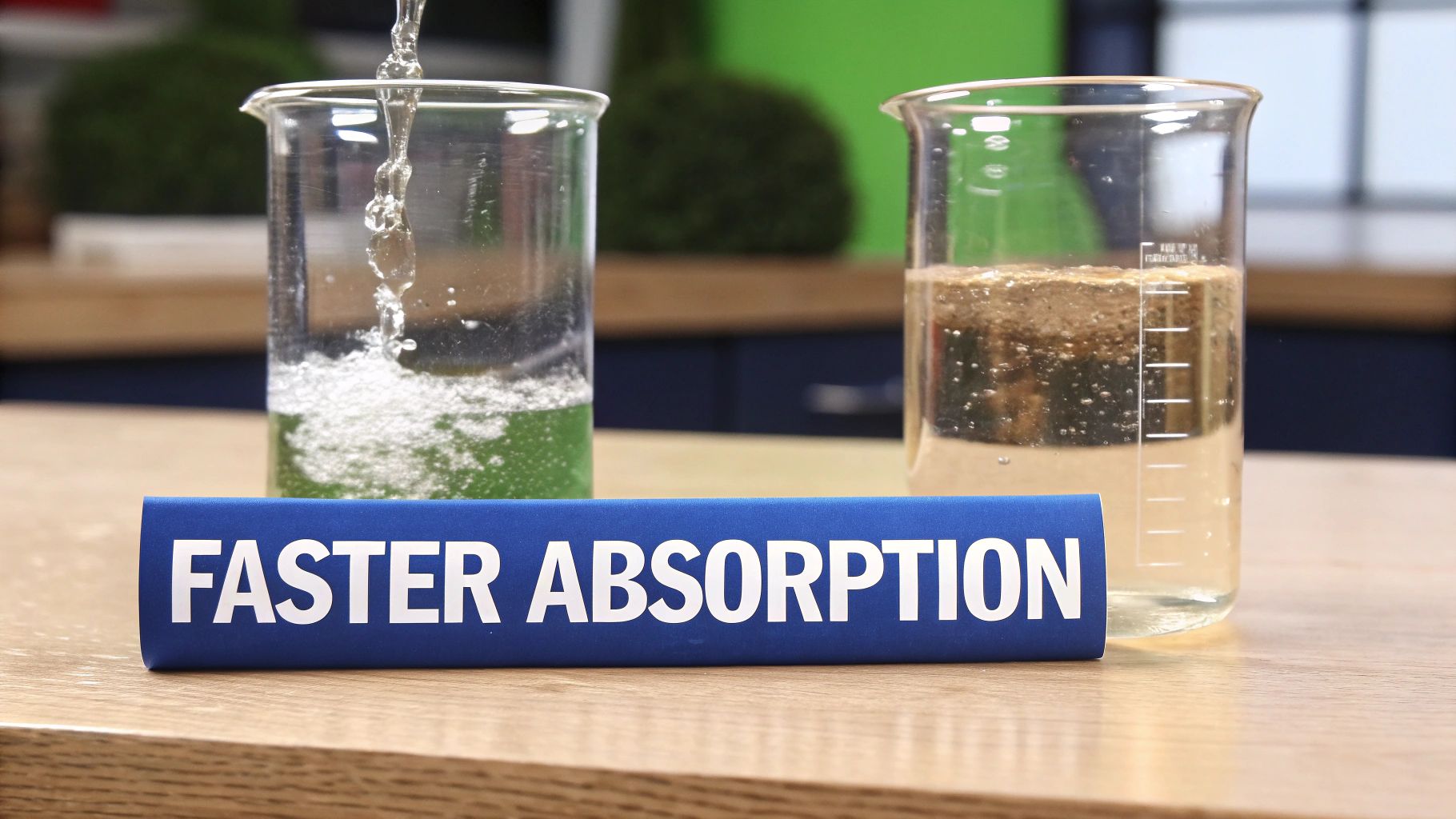
This isn't just theory; it has real-world implications for how quickly your customers feel the effects. While speed isn’t critical for a daily multivitamin, a faster onset of action can be a powerful selling point for products like energy shots or sleep aids.
The Science of Nutrient Uptake
Bioavailability is about more than just speed—it’s about the total amount of a nutrient that gets absorbed. Liquids have a natural advantage, but true innovation happens in the formulation science. As your manufacturing partner, our expertise is in creating advanced delivery systems that maximize nutrient uptake.
Consider fat-soluble vitamins like A, D, E, and K. For the body to absorb them effectively, they must be delivered in a fat-based solution. Our formulators are experts at creating perfectly stable emulsions that ensure these critical nutrients are in the ideal state for absorption from the moment they're consumed.
Research supports this. Clinical studies show that liquid formats like liposomal or emulsified solutions can lead to higher bloodstream concentrations of certain vitamins. Some studies have even found that liposomal vitamin C can result in ~30% higher plasma concentrations compared to a standard pill. Yet, pills still dominate the market, highlighting a clear trade-off brands make between convenience and targeted absorption—a trend confirmed in recent analyses of the liquid dietary supplements market.
Key Takeaway: For private-label brands, the bioavailability argument is a powerful differentiator. It’s not just a "liquid vs. pill" debate. It’s about leveraging formulation science to create a product that delivers superior results for your customers.
Practical Implications for Your Brand
So, what does this mean for your business strategy? Leaning into superior absorption can justify a premium price point and build incredible brand loyalty. It gives you the power to craft marketing narratives around efficacy and tangible results.
Think about these scenarios:
- A Children's Vitamin Line: Parents demand effectiveness and ease of use. A great-tasting liquid vitamin with high bioavailability checks both boxes perfectly.
- An Athletic Performance Blend: Athletes need rapid nutrient delivery post-workout. A liquid can shuttle amino acids and electrolytes into their system much faster.
- A Senior Wellness Product: As we age, our digestive systems can become less efficient. A pre-dissolved liquid ensures older adults get the full benefit of every dose.
Ultimately, your choice depends on your specific formula and target audience. Pills offer undeniable convenience, but a well-formulated liquid gives you a clear performance advantage. For a deeper dive, check out our analysis on whether liquid vitamins are better than pills. As your R&D partner, we’re here to help you navigate these details and build a product that truly shines.
Diving Into Manufacturing and Formulation
Every successful supplement is built on a solid manufacturing and formulation plan. The journey from raw ingredients to a finished product is completely different for liquids versus pills, and understanding these technical nuances is non-negotiable for a private-label brand manager. This is where a true manufacturing partner proves their value—acting as an extension of your R&D team.
The process for a liquid supplement is an exercise in chemical precision. Unlike pills, which are essentially blended and compressed powders, liquids demand a much more sophisticated approach. The primary challenge? Ensuring every active ingredient remains stable and potent in a complex solution.
This requires preventing ingredients from degrading, separating, or reacting over time—a task that demands serious formulation expertise. As your partner, we manage these complexities in our cGMP, UL certified, and FDA-registered facility to ensure the potency on your label is exactly what your customer gets in every drop.
The Art and Science of Liquid Formulation
Creating a liquid vitamin that's both stable and effective involves several crucial steps you don't encounter with other formats. Each stage is an opportunity for innovation and quality control.
Here’s our checklist for liquid manufacturing:
- Ingredient Stability and Suspension: We ensure all botanicals and nutrients stay evenly distributed and potent throughout the product's shelf life. This often involves creating precise emulsions or suspensions to prevent settling.
- Effective Flavor Masking: Let's be direct: many herbal extracts and active ingredients taste terrible. Our formulators are masters at developing custom flavor profiles that make your product genuinely enjoyable, without relying on excessive sugar or artificial additives.
- Preservation and Purity: Liquids are more susceptible to microbial growth than dry pills. We utilize advanced, clean preservation systems to guarantee safety and stability, avoiding harsh chemicals that would undermine a clean-label promise.
We leverage forward-thinking solutions like cold-fill technology to protect heat-sensitive ingredients, such as probiotics and certain enzymes. This process maintains the integrity of delicate compounds that traditional heat pasteurization would destroy, ensuring your product delivers its full benefit.
Our commitment to quality is absolute. From advanced botanical extraction methods to rigorous third-party testing, we ensure every bottle meets the highest standards. To get a closer look at our process, review our guide to nutraceutical formulation development.
The Mechanical Precision of Pill Manufacturing
While it may seem simpler, producing a high-quality tablet or capsule is a matter of mechanical precision with its own set of challenges. The goal is to create a solid dose that's consistent, stable, and disintegrates effectively. This requires a skillset focused on physical properties rather than chemical solutions.
The key steps and considerations include:
- Binder and Excipient Selection: The "inactive" ingredients are critical. We meticulously select binders to hold the tablet together, fillers for uniform size, and disintegrants to ensure it breaks apart at the right time.
- Tablet Compression: This is a highly controlled process. Too little pressure and the tablet crumbles; too much and it may not dissolve properly, compromising bioavailability. We calibrate our machinery for the perfect density for every formula.
- Applying Coatings: Many tablets are coated to make them easier to swallow, mask taste, or protect ingredients from stomach acid. This final step requires precision to apply a smooth, even layer that doesn’t interfere with the tablet's performance.
The manufacturing process you choose will define your product's quality. Whether you're navigating the chemical complexities of a liquid or the mechanical precision of a pill, partnering with an expert manufacturer is the key to creating a product that builds customer trust and loyalty.
Comparing The Consumer Experience and Dosing
How a customer uses your product every day determines their loyalty and your brand's success. When comparing liquids against pills, the end-user experience is a critical factor that directly impacts compliance and satisfaction. You must align your product format with the lifestyle of your target customer.
Liquid supplements offer a completely different user journey—one centered on precision and sensory engagement. Their biggest advantage is dosing flexibility. A parent can easily adjust a child’s vitamin C dose by a few milliliters. An athlete can micro-dose a potent herbal blend based on their training schedule. This level of control is simply impossible with a fixed-dose capsule.

Addressing Pill Fatigue and Sensory Appeal
"Pill fatigue" is a real and growing issue. Many consumers, especially those managing multiple supplements, are tired of swallowing pills. A liquid alternative can transform this daily chore into a more enjoyable wellness ritual, especially when formulated with a pleasant, natural flavor.
That sensory experience—the taste, texture, and aroma—is a powerful differentiator. It creates a memorable and positive interaction with your brand that a tasteless pill cannot replicate.
As your R&D partner, we see this as a key strategic advantage. A well-crafted liquid formula isn't just a supplement; it's a premium experience that can command a higher price point and build a devoted following. We help you develop custom flavor profiles that make taking vitamins something customers actually look forward to.
The Unmatched Convenience of Pills
On the other side of the coin, when it comes to pure convenience and portability, pills and capsules remain king. For the on-the-go consumer, nothing beats the simplicity of tossing a bottle of capsules into a gym bag or purse. There is no measuring, no risk of spills, and no need for refrigeration.
This grab-and-go ease makes pills the default choice for a huge market segment that values speed and simplicity above all else.
Consumer Experience Snapshot
| Factor | Liquid Vitamins | Pill Vitamins (Tablets/Capsules) |
|---|---|---|
| Dosing Control | High. Allows for precise, adjustable dosing, ideal for children, seniors, and specific protocols. | Low. The dosage is fixed per unit, offering simplicity but no room for customization without breaking tablets. |
| Swallowing | Effortless. Perfect for the ~30-35% of adults who report difficulty swallowing pills, as well as pediatric and geriatric users. | Challenging for some. Can be a significant barrier for certain demographics, leading to lower compliance. |
| Portability & Travel | Moderate. Requires careful packing to prevent leaks and may need refrigeration, making it less convenient for travel. | Excellent. Highly portable, stable at various temperatures, and requires no special handling. |
| Routine Integration | More involved. Requires measuring, creating a more mindful daily ritual. | Seamless. Integrates easily into any routine with a simple swallow of water, taking mere seconds. |
Ultimately, the "best" consumer experience depends entirely on who you're trying to reach. If your brand targets customized wellness for specific populations, the flexibility of a liquid is a clear winner. But if you're aiming for mass-market appeal with a focus on convenience, the sheer simplicity of a pill remains an incredibly powerful choice.
Analyzing Cost, Packaging, and Logistics
For any e-commerce founder or brand manager, this is where theory meets reality. While formulation science is fascinating, your profit margins and operational efficiency depend on the practicalities of packaging, shipping, and storage. Getting this wrong can sink an otherwise excellent product.
At a high level, be prepared for a higher per-unit cost with liquid supplements. This is due to a cascade of specialized needs—from the bottle itself to heavier shipping weights—that pills simply don’t have. Every step adds an expense that must be built into your business model.
In contrast, pills are the champions of logistical efficiency. Their low weight, standardized packaging, and incredible stability make them far easier and cheaper to produce, store, and ship, especially at scale.
Breaking Down the Cost Structure
The financial comparison between liquid and pill vitamins goes far beyond just the active ingredients. As your manufacturing partner, we provide total transparency in our cost breakdowns so you can make strategic decisions that fit your budget.
Here’s a look at the main cost drivers:
- Packaging Materials: Liquids require more expensive materials, typically glass or high-grade, non-reactive plastic bottles, often paired with droppers or metered caps. These are more costly than the simple plastic bottles used for capsules.
- Manufacturing Complexity: As noted, liquid formulation involves precise temperature controls, flavor masking, and stabilization. These extra steps require more specialized equipment and time, which is reflected in the manufacturing cost.
- Shipping Weight: This is a critical factor. A case of liquid supplements weighs substantially more than a case of pills, which directly translates into higher freight and last-mile delivery costs—a crucial variable for any D2C brand.
Partnership Insight: We help you navigate these variables. By offering run sizes from small pilot batches to full-scale production, you can test the market with a liquid product without a massive upfront capital commitment. This is the smart way to validate your concept before going all-in.
E-Commerce Fulfillment and Packaging Durability
When you’re selling on platforms like Amazon FBA or Walmart, your packaging must withstand the harsh realities of automated warehouses. Durability is non-negotiable.
Liquid supplements, particularly in glass bottles, are at a higher risk of breakage. This requires more robust and expensive secondary packaging, like custom-fit boxes, just to meet fulfillment center requirements like Amazon's drop-test standards.
Pills are far more resilient. Being solid and lightweight, they can often be shipped in simpler, cheaper packaging, reducing both material and shipping costs and lowering the risk of damaged inventory. We partner with you to design packaging that is both on-brand and fully compliant, ensuring a smooth fulfillment process from our facility to your customer’s doorstep. Our rapid turnaround times and on-time delivery record mean you can count on us to keep your supply chain moving.
Here's a direct comparison of the key logistical considerations.
Cost and Logistics Snapshot
| Factor | Liquid Vitamin Implications | Pill Vitamin Implications |
|---|---|---|
| Per-Unit Production Cost | Generally higher due to specialized bottling, complex formulation, and flavor masking. | Lower due to standardized, high-speed, and highly automated manufacturing processes. |
| Shipping & Freight | Heavier weight leads to significantly higher shipping costs, directly impacting profit margins. | Lightweight and compact, resulting in much lower shipping expenses and easier handling. |
| Packaging Requirements | Requires durable, often glass, leak-proof bottles and robust secondary packaging for e-commerce. | Simple, low-cost plastic bottles and standard mailers are often sufficient and compliant. |
| Storage & Stability | May require temperature-controlled storage and has a shorter shelf life, especially once opened. | Highly stable with a long shelf life, typically requiring no special storage conditions. |
While pills often present a more straightforward path from a cost and logistics perspective, the unique market positioning and premium value of a liquid can certainly justify the added complexity for the right brand.
Making The Right Choice For Your Brand
After breaking down everything from bioavailability to shipping logistics, it all comes down to one critical question: who is your ideal customer? The choice between a liquid or pill vitamin isn't about which one is universally "better." It's about which one is strategically right for the audience you want to reach and the brand you want to build. This decision is the cornerstone of your product's identity.
A clear strategy starts with a clear target. A premium liquid formula boasting superior absorption is a perfect fit for a niche wellness audience that puts efficacy above all else. On the other hand, a brand targeting busy professionals who need convenience will find more success with the simple, grab-and-go nature of pills.
Aligning Format With Brand Vision
Your product's format is a direct reflection of your brand's promise. To make the right call, you need to decide which strategic path you're taking.
-
The High-Efficacy, Premium Path (Liquid): This route is for brands built on scientific validation and superior results. You're targeting a discerning customer who will pay more for a product they believe works better. Your marketing should focus on absorption rates, custom dosing, and a premium user experience—all of which justify a higher price point.
-
The Convenience and Scale Path (Pill): This path is for brands aiming for broad market appeal and operational efficiency. Your customer values simplicity, portability, and an affordable price. Your competitive edge will come from cost-effective scaling, streamlined logistics, and a product that fits seamlessly into a hectic lifestyle.
This decision tree helps visualize how your target customer's priorities should directly guide your format choice.
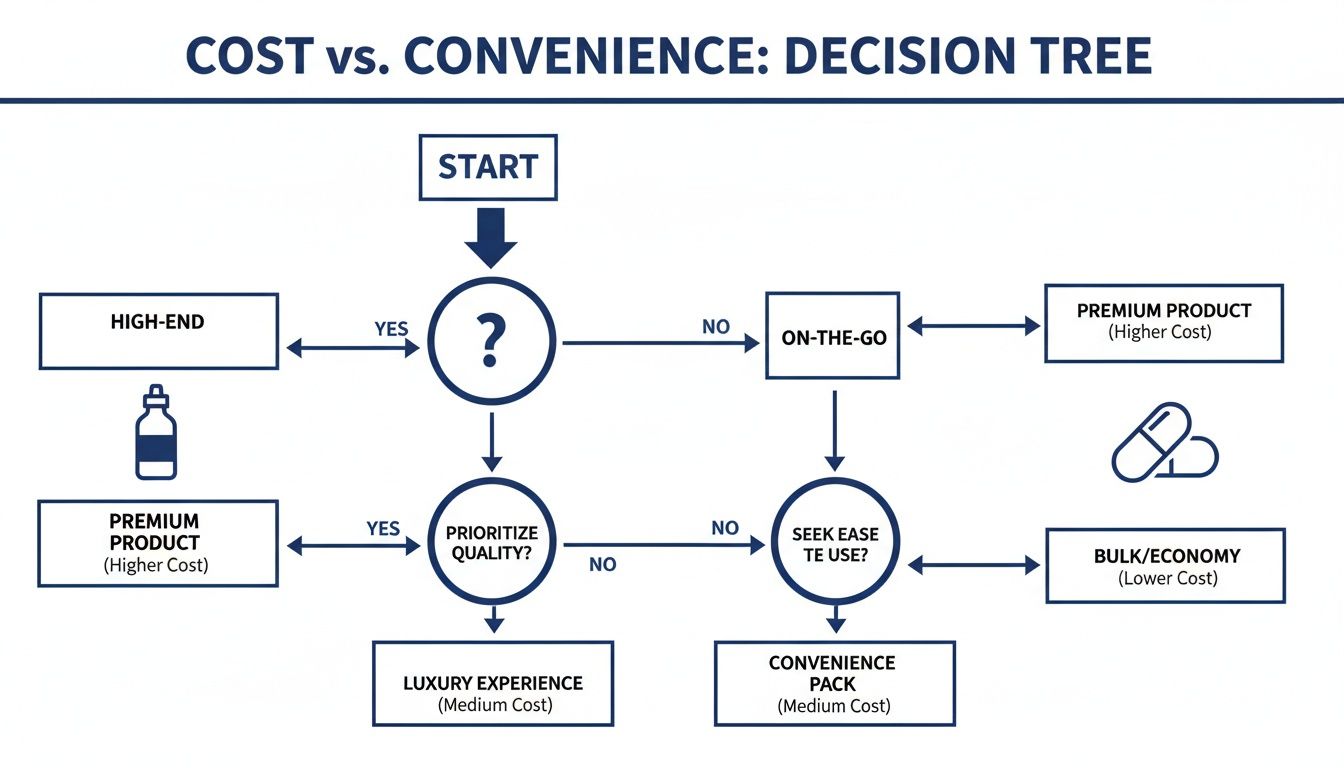
As you can see, a brand focused on a high-end, quality-driven consumer should lean toward liquids. A brand that prioritizes convenience for an on-the-go audience will find pills to be the more effective option.
Your Partner From Concept To Launch
Ultimately, this decision is about more than just a delivery system; it's about creating a product that truly resonates with your intended market. And of course, the product itself is just one piece of the puzzle. For a deeper look at the business side of the supplement industry, check out this case study on how a supplement brand increased its revenue by 25x.
As your R&D partner, we excel at turning strategic alignment into tangible reality. Our team collaborates with you to translate your brand vision into a high-quality, market-ready product that stands out. We are here to help turn your concept into a success story.
Navigating these complexities is what we do best. With deep expertise in both liquid and solid dose manufacturing, we provide the guidance, flexibility, and quality assurance you need to succeed. Whether you’re launching your first product or scaling an existing line, our cGMP, UL certified, and FDA-registered facility is ready to bring your vision to life with speed and reliability.
Ready to create a supplement that connects with your audience? Let's talk about your project. Contact us today to request a consultation and start building your next best-seller with a reliable manufacturing partner by your side.
Common Questions from Founders
As you're weighing the options, you probably have a few specific questions about how this choice between liquids and pills will play out for your business. Let's tackle some of the most common ones we hear from our partners.
Are Liquid Vitamins Always Better Absorbed Than Pills?
Not always. While liquids have an advantage by not needing to be broken down, bioavailability depends on the specific nutrient and formula quality. A well-made, fast-dissolving tablet can be highly effective for many standard vitamins.
The real advantage for liquids emerges with trickier ingredients. For fat-soluble vitamins (A, D, E, and K) or complex herbal extracts, an advanced liquid format like an emulsion or liposome can dramatically improve absorption. Our R&D team's job is to analyze your ingredients and recommend the delivery system that will perform best.
What Are The Biggest Challenges For A Liquid Supplement Startup?
For new liquid brands, the main hurdles are typically product stability, flavor, and higher initial costs.
- Stability: This is pure formulation science. It requires deep expertise in preservatives and suspension agents to prevent ingredients from separating or degrading.
- Flavor Masking: Many botanical ingredients taste unpleasant. The art lies in creating a great flavor profile without excessive sugar or artificial additives—critical for customer compliance.
- Upfront Costs: The economics are different. Glass bottling, heavier shipping, and more complex manufacturing result in a higher per-unit cost compared to pills.
To help new brands navigate this, we offer flexible production runs. This allows you to launch with a smaller pilot batch to test the market before committing to a full-scale order, demonstrating our commitment to customization and flexibility.
How Does Product Format Affect Selling On Amazon FBA?
Both pills and liquids can succeed on Amazon, but they have different logistical requirements that impact your prep costs. The main difference is durability.
Pills are simpler. They're lightweight, resilient, and easy to prep for FBA, making them cheaper and faster to get into Amazon's fulfillment network.
Liquids, especially in glass bottles, are treated as fragile items by Amazon. They require robust, leak-proof packaging that can pass rigorous drop tests. You will likely need to invest in custom boxes or protective inserts, adding to your Cost of Goods Sold (COGS). We specialize in designing packaging that is both brand-aligned and fully compliant with Amazon's rules, ensuring your products are checked in smoothly.
Ready to determine the best format for your brand? The team at Triton Nutra Group is here to act as your R&D and manufacturing partner, guiding you from concept to a shelf-ready product. Request a quote today and let's build your next success story together.
