Design Your Own Supplement: A Founder's Guide
Ready to design your own supplement? This founder's guide covers formulation, manufacturing, regulations, and scaling your brand from concept to launch.
 Get a Free Quote Today!
Thinking about how to design your own supplement? It’s a smart move. Consumers are tired of generic, one-size-fits-all products. They demand personalized health solutions, creating a massive opportunity for brands that can deliver.
Your path forward comes down to two main options: private labeling a proven formula or creating a fully custom product from scratch. This single decision shapes everything—from your launch timeline to your brand’s unique position in a crowded market.
Capturing the Custom Supplement Opportunity
For brand managers and e-commerce founders, the market signal is loud and clear. Consumers are actively searching for supplements tailored to their specific health goals, dietary needs (like keto or vegan), and lifestyles. This shift is fueling the custom supplement boom.
The numbers don't lie. The global dietary supplements market was valued at USD 203.56 billion in 2024 and is projected to hit nearly USD 435.42 billion by 2034. This explosive growth, driven by a focus on preventive health, confirms that now is the time to enter the market. You can see the full breakdown in this detailed report on Zion Market Research.
Finding Your Path to Market
So, where do you begin? The journey to launch your supplement brand follows one of two paths. The right choice depends on your business goals, investment level, and how innovative you want your product to be.
- Private Label (White Label) Manufacturing: This is your fastest ticket to market. You select a pre-made, lab-tested formula from a manufacturer's catalog and apply your own branding. It’s a low-risk, cost-effective way to get your brand launched quickly.
- Contract Manufacturing (Custom Formula): This route offers complete creative control. You work directly with an R&D team to build a unique formula, choosing every ingredient, dose, and flavor. It requires a larger investment, but it’s how you create a truly differentiated product.
This visual outlines the journey from market analysis to choosing the right manufacturing path for your brand.
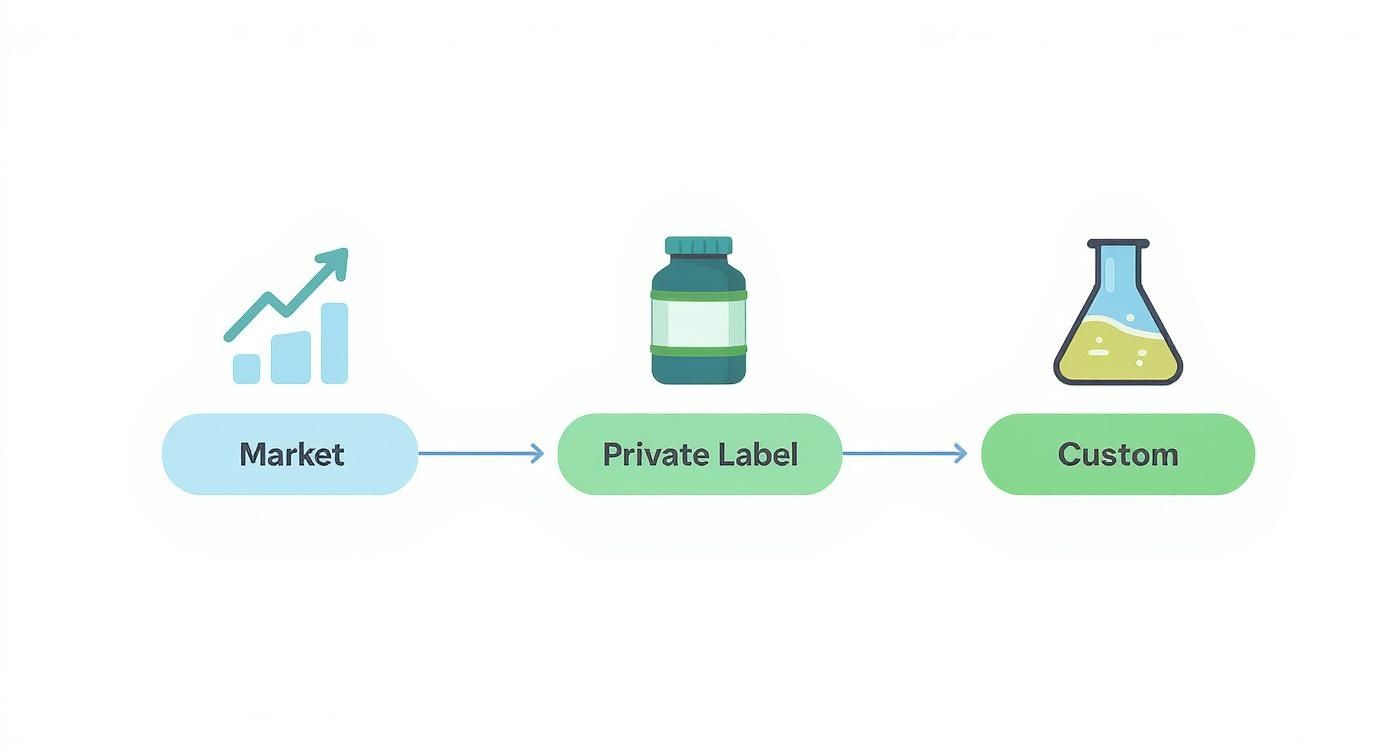
The choice between private label's speed and a custom formula's uniqueness is a direct response to your market strategy.
Your supplement is your brand's promise. Choosing the right manufacturing partner isn't just a supply chain decision—it’s a commitment to the quality, safety, and compliance that defines your reputation.
Making the Right Strategic Choice
Deciding between private label and a custom formula is the foundational step for your business. To clarify which path is right for you, here’s a direct comparison.
| Aspect | Private Label (White Label) | Contract Manufacturing (Custom Formula) |
|---|---|---|
| Speed to Market | Very fast (weeks) | Slower (months) |
| Upfront Cost | Lower (no R&D costs) | Higher (R&D, testing, ingredient sourcing) |
| Minimum Order Quantity (MOQ) | Typically lower | Typically higher |
| Product Uniqueness | Low (formula is shared with others) | High (formula is 100% exclusive to you) |
| Control Over Formula | None (you choose from existing options) | Complete control over every detail |
| Best For | New brands, market testing, speed | Established brands, innovators, unique needs |
A private label approach is ideal if your goal is rapid market entry and idea validation. You can test customer demand without a significant R&D investment. You could have a product ready for sale in just a few weeks.
Conversely, if your brand is built on a novel ingredient blend or a specific scientific discovery, a custom formula is the only path forward. This approach positions you as an industry innovator and creates a product your competitors cannot replicate.
For a deeper dive into business planning, review our guide on how to start a supplement business. It will help place this crucial decision into your broader strategic context.
From Concept to a Market-Ready Formula

The journey to design your own supplement starts with a single idea. But turning that concept into a physical product requires a clear, methodical process. This is where your vision becomes a precise, effective, and marketable formula.
It all begins with your customer. Move beyond a broad goal like "an energy supplement." Instead, define the exact problem you are solving for a specific audience. Are you targeting professionals who need sustained mental focus without jitters? Or athletes who require explosive pre-workout fuel?
Nailing down this user profile is the foundation of your product. It dictates every choice, from ingredients and dosages to the final flavor profile.
Defining Your Product's Core Purpose
To build a formula that resonates, you must get granular about its function. A vague concept leads to a generic product that gets lost on the shelf. A strong R&D partner helps you ask the right questions and map out the specifics.
Consider how a simple idea evolves:
- The Vague Idea: "I want to create a sleep supplement."
- The Refined Concept: "I'm creating a non-groggy sleep aid for professionals who struggle to unwind after a high-stress day. It must promote relaxation and support deep sleep without causing next-day drowsiness."
That refined concept immediately provides direction. We know to focus on compounds that support the body's natural sleep cycle and avoid ingredients known to cause morning fog.
The most successful supplements are born from an obsession with a specific customer problem. Your formula isn't just a list of ingredients; it's the targeted solution your audience has been searching for.
Once the purpose is locked in, formulation begins. This involves selecting evidence-backed ingredients that work synergistically, determining optimal dosages, and choosing the right delivery format. To go deeper into this critical stage, learn more about how to create a supplement formula in our detailed guide.
Selecting Ingredients and Perfecting the Experience
With a clear customer and purpose, ingredient selection becomes strategic. An experienced manufacturing partner brings deep knowledge of botanical extracts and active compounds, guiding you toward ingredients with solid scientific backing.
For our sleep supplement example, this might mean exploring:
- Magnesium Glycinate: Known for its calming effects on the nervous system and excellent bioavailability.
- L-Theanine: An amino acid found in green tea that promotes relaxation without sedation.
- Apigenin: A natural compound from chamomile that may help reduce sleep onset time.
The delivery format is equally important. Will your product be a fast-acting liquid tincture, a convenient capsule, or a mixable powder? For liquid herbal supplements, flavoring is a key differentiator. An unpalatable product kills customer retention, no matter how effective it is. The art of formulation shines here—transforming potent botanicals into something enjoyable, like a soothing cherry-vanilla liquid.
The demand for these carefully crafted products is undeniable. Designing your own dietary supplements directly meets the growing consumer need for personalized nutrition. This trend is fueling a global market projected to be worth approximately USD 187.5 billion in 2025, with forecasts showing it could nearly double by 2033. The Asia Pacific region alone accounts for a 36.25% market share, proving this desire for custom wellness is a worldwide movement. Creating a unique, well-formulated product puts your brand right at the center of a major market opportunity.
Choosing Your Manufacturing Partner

This is where your brand’s reputation is forged. The leap from a perfected formula to a physical product depends entirely on your manufacturing partner. When you design your own supplement, you are making a promise of quality and safety. Your manufacturer is who helps you keep it.
This is not about finding the lowest bidder. It’s about finding a true partner who prioritizes transparency and quality. The right manufacturer acts as an extension of your team—your R&D partner from concept through launch.
The Non-Negotiables of Quality and Compliance
In the supplement industry, certifications aren't just website badges—they are your brand's shield. They provide third-party proof of a partner's commitment to safety and quality. When vetting potential manufacturers, these credentials are non-negotiable.
Here’s what you must look for:
- cGMP Certified: This is the baseline. Current Good Manufacturing Practices, enforced by the FDA, ensure that every part of the production process is properly designed, controlled, and monitored.
- FDA-Registered Facility: While the FDA doesn’t “approve” supplements, all facilities must register with the agency. This subjects them to inspections and holds them accountable to federal standards.
- UL Certified: A UL certification provides an extra layer of confidence. It involves rigorous, independent audits of manufacturing processes, confirming your partner meets the highest industry benchmarks for quality and safety.
These certifications are the bedrock of customer trust. They confirm your partner has the systems to produce a safe, consistent product, batch after batch.
A manufacturing partner’s commitment to quality is a direct reflection of your own. Every bottle that leaves their facility has your brand's name on it, making their compliance your reputation.
More Than a Supplier: A True R&D Partner
The best manufacturing relationships are true partnerships. A real partner collaborates with you, meticulously sourcing raw materials and verifying the purity and potency of each ingredient before it enters your formula.
This partnership includes bulletproof testing protocols. A reliable manufacturer will insist on comprehensive third-party testing for finished products. This independent verification is your proof that what’s on the label is exactly what’s in the bottle. For a deeper look, our guide on finding a reputable supplement manufacturer is a valuable resource.
This collaborative approach is also where innovation happens. A forward-thinking partner invests in technologies that protect your formula's integrity. For example, for sensitive liquid botanicals, cold-fill processing is a game-changer. By avoiding heat, it preserves the delicate compounds that would otherwise be destroyed, ensuring your product delivers maximum efficacy.
Flexibility for Growth: From Pilot Batches to Full Scale
Your business needs will evolve, and you need a manufacturer who can scale with you. A key indicator of a great partner is their flexibility with production sizes.
Look for a manufacturer who offers:
- Pilot Runs: The ability to produce small test batches is invaluable. It lets you validate your formula and get customer feedback without a massive inventory investment.
- Scalable Production: Once your product takes off, you need a partner who can seamlessly shift to full-scale production runs without sacrificing quality or speed.
This flexibility is crucial for managing cash flow and making smart, data-driven decisions. A partner who provides reliable, transparent, and speedy support is the asset you need to turn your vision into a reality.
Navigating FDA Compliance and Label Design
You’ve developed a winning formula and secured a quality-focused manufacturing partner. Now it's time to tackle regulation and branding: compliance and label design.
Navigating FDA guidelines can feel daunting, but it's a structured process designed to protect you and your customers. Getting compliance right is the foundation of your brand’s credibility. It is a non-negotiable step that signals your product is professional, safe, and trustworthy.
Let's walk through the essentials to create a label that's 100% compliant and stands out on the shelf.
Mastering the Supplement Facts Panel
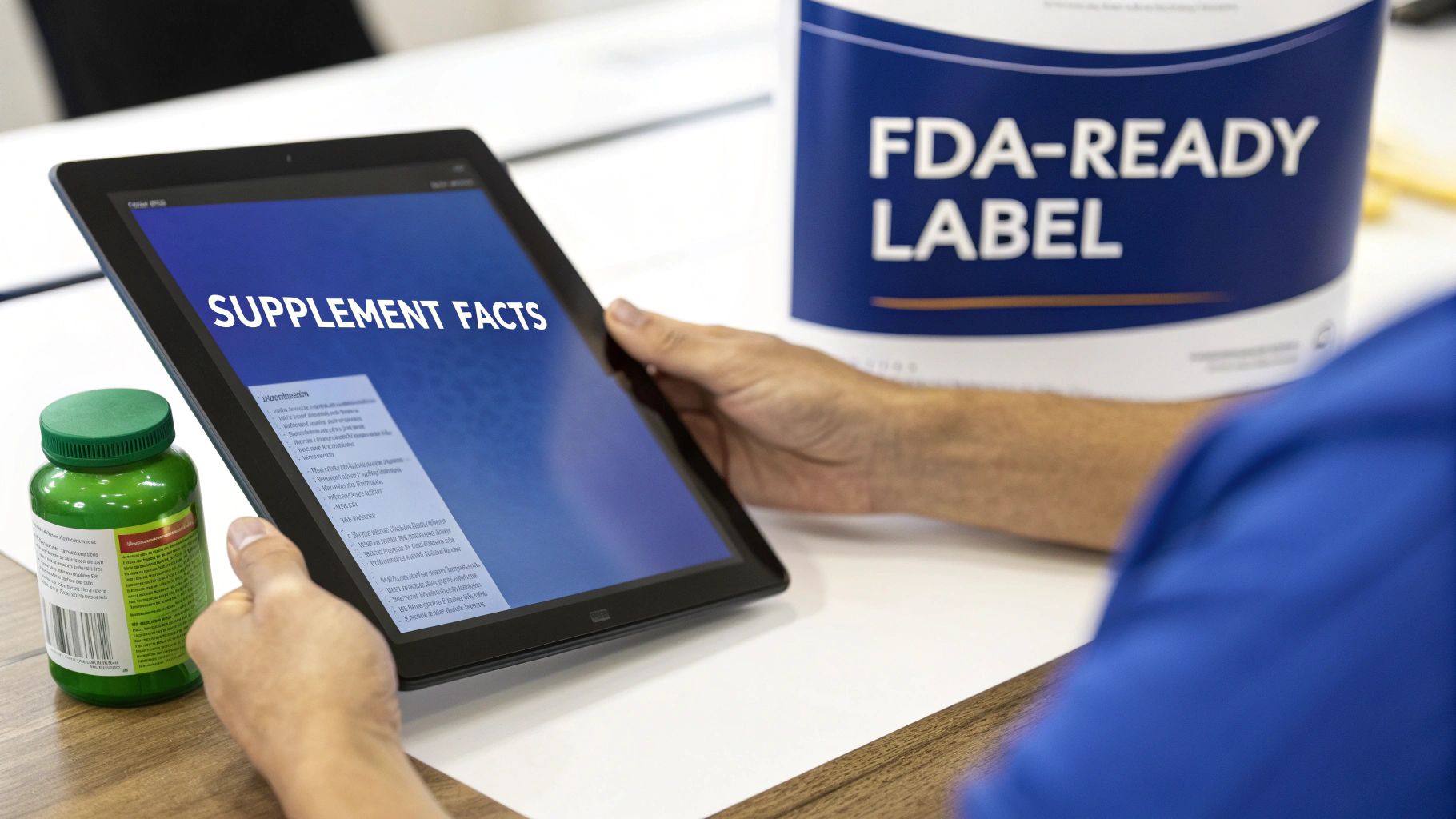
The centerpiece of your label is the Supplement Facts panel. This is not a casual list of ingredients; it's a legally required format with highly specific rules. The FDA mandates this panel to ensure complete transparency for consumers.
The FDA's official labeling guide requires you to clearly state the serving size, all active ingredients, and their quantities per serving. The formatting—font sizes, line thickness, and layout—is standardized for easy readability.
Structure-Function Claims vs. Disease Claims
The marketing language you use is under a microscope. You must understand the difference between a legal structure/function claim and an illegal disease claim. Confusing the two can put your brand in serious regulatory jeopardy.
Here’s the breakdown:
-
Structure/Function Claims (Permitted): These describe how an ingredient supports the body's normal, healthy functions. Examples include "Calcium builds strong bones" or "Supports a healthy immune system." They are permissible as long as they are truthful and you include the standard FDA disclaimer: "This statement has not been evaluated by the Food and Drug Administration. This product is not intended to diagnose, treat, cure, or prevent any disease."
-
Disease Claims (Forbidden): These claims suggest your product can diagnose, treat, cure, or prevent a specific disease. Statements like "Lowers high cholesterol" or "Treats arthritis" are prohibited. A disease claim instantly reclassifies your supplement as an unapproved drug in the eyes of the FDA, with severe penalties.
Your marketing copy must walk a careful line. Always focus on supporting the body's natural processes, never on fixing a medical condition. Your contract manufacturer should offer a final label review to ensure your claims are compliant.
Designing a Label That’s Both Compliant and Compelling
Once regulatory requirements are met, it’s time to design a label that grabs attention and tells your brand’s story. For many customers, your label is their first interaction with your product.
Keep these key elements in mind for a standout design:
- Clear Brand Identity: Your logo, colors, and fonts should be consistent and instantly communicate your brand's positioning. Is your brand clinical and scientific, or natural and holistic?
- Premium Materials: The feel of the label—whether high-gloss, matte, or foiled—can dramatically boost the perceived value of your product.
- The Unboxing Experience: Think beyond the bottle. Custom boxes, printed inserts, or a QR code to a "how-to" video can create a memorable experience and earn great reviews.
A winning label accomplishes two things at once: it meets every FDA requirement without fail, and it tells a compelling brand story that connects with your ideal customer.
Supplement Development Timelines and Costs
Bringing a new supplement to market involves several phases, each with its own timeline and cost. For founders, a realistic grasp of these numbers is critical for budgeting and setting launch expectations.
Here's a high-level look at what you can generally expect.
| Phase | Typical Timeline | Estimated Cost Range (Varies by Complexity) |
|---|---|---|
| 1. Ideation & Research | 2–4 weeks | $0–$1,000 |
| 2. Formulation & Sourcing | 4–8 weeks | $1,500–$7,500+ |
| 3. Testing & Prototyping | 6–12 weeks | $3,000–$10,000 |
| 4. Regulatory & Label Design | 3–6 weeks | $1,000–$5,000 |
| 5. Pilot & Full Production | 8–14 weeks | $15,000–$50,000+ (Based on MOQ) |
These are estimates. A simple, single-ingredient formula will be on the lower end, while a complex product with novel ingredients and extensive stability testing will be on the higher end. Planning for these figures will help you build a solid financial roadmap.
Building Your Go To Market Strategy
You have a finished, compliant, and beautifully packaged product. Now, the real work begins: building a business around it. A great supplement can fail without a smart plan to get it in front of the right people.
Your go-to-market (GTM) strategy is the playbook for your launch. It’s a holistic plan that connects sales channels, logistics, and customer acquisition into a cohesive growth engine.
Choosing Your Sales Arena: Amazon FBA vs. Shopify
One of the first decisions you’ll make is where to sell your supplement. For most e-commerce brands, this boils down to two primary channels: selling on Amazon via FBA or building your own direct-to-consumer (DTC) store on Shopify.
Selling on Amazon FBA (Fulfillment by Amazon):
- Massive, built-in audience. Instantly access millions of shoppers who are ready to buy.
- The power of Prime. FBA makes your product eligible for Prime shipping, a massive conversion driver.
- Hands-off logistics. Amazon handles storage, picking, packing, and shipping, removing a huge operational burden.
Selling on Shopify (Direct-to-Consumer):
- Total brand control. You own the entire customer experience—from the website design to the checkout process.
- Direct customer relationships. Collect valuable customer data, build a community, and re-market effectively.
- Higher profit margins. While you must drive your own traffic, you keep more of the revenue compared to Amazon’s referral and FBA fees.
Many successful brands eventually use a hybrid approach, leveraging both channels. Regardless of your choice, a comprehensive marketing plan is essential to guide your efforts.
Your sales channel is where your brand comes to life. Amazon offers unrivaled traffic, but Shopify gives you a home you can build and own. Choose the one that best aligns with your long-term vision.
Building Initial Momentum and Social Proof
Regardless of where you launch, the first 90 days are critical. A successful launch is about generating early sales velocity and, most importantly, social proof in the form of customer reviews.
Here’s a practical game plan for gaining early traction:
- Pinpoint Your Day-One Buyers: Before going live, build a list of people likely to buy immediately—social media followers, email subscribers, or friends and family.
- Craft an Irresistible Launch Offer: Create urgency with a time-sensitive discount or a special bundle to drive a large sales spike right away. This signals to the platform's algorithm that your product is popular.
- Systematize Your Review Process: Don't just hope for reviews—ask for them. Use automated email follow-ups or tools like Amazon's "Request a Review" button to politely solicit feedback from every customer.
The objective is to create a flywheel where initial sales generate reviews, which builds trust and leads to more sales.
Nailing Your Fulfillment and Logistics
How your product gets into your customers' hands is the final piece of the puzzle. Your fulfillment must be reliable, scalable, and cost-effective.
You have two main paths for logistics:
- Self-Fulfillment: You store, pack, and ship every order yourself. This offers maximum control and is cost-effective at low volumes.
- Third-Party Logistics (3PL): You outsource warehousing and shipping to a specialized company. A 3PL partner provides the expertise and infrastructure to scale efficiently, freeing you to focus on growth.
As your brand grows, moving from self-fulfillment to a 3PL is a natural and necessary step. A well-executed launch plan that integrates your product, marketing, and logistics will build a strong foundation for long-term success.
Got Questions About Launching Your Supplement?
Diving into custom supplements is exciting, but it brings up questions. As you move from idea to a market-ready product, it’s normal to wonder about timelines, costs, and potential hurdles.
This is your practical, no-fluff FAQ, with direct answers based on our experience as an R&D partner. Our goal is to replace uncertainty with a clear, actionable plan so you can move forward with confidence.
What's the Minimum Order to Get Started?
Minimum Order Quantities (MOQs) are a major consideration for new brands managing cash flow. The required commitment depends on your manufacturing route.
For a pre-existing private label formula, where R&D is complete, manufacturers may offer MOQs as low as 100-500 units. It's a great way to test the market.
For a fully custom formula, the process is more involved. It requires unique ingredient sourcing, dedicated R&D time, and a custom production run. Consequently, MOQs for custom work typically start in the 1,500-3,000 unit range.
We understand that committing to thousands of units is a big step. That’s why we offer pilot run options. This allows you to produce a smaller test batch to prove your concept before committing to a full-scale order.
How Long Does This Whole Process Actually Take?
From project kickoff to holding a finished product, you should realistically budget for three to six months. This timeframe covers all the critical steps for creating a high-quality, compliant supplement.
Here’s a rough breakdown of that timeline:
- R&D and Formulation (4-8 weeks): We collaborate to finalize your unique formula.
- Ingredient Sourcing (2-4 weeks): We secure high-purity raw materials from our network of vetted suppliers.
- Full-Scale Production (4-6 weeks): Your formula is manufactured, bottled, and labeled in our cGMP-certified facility.
Keep in mind that stability testing, if required, can add another 4-12 weeks. A transparent manufacturing partner will provide a detailed project schedule from day one, so you know exactly what to expect.
A clear timeline isn't just a schedule; it's our commitment. It ensures every step is executed with precision, getting your product to market reliably and on time.
What Are the Biggest Regulatory Hurdles I Need to Avoid?
Navigating regulations is non-negotiable. Getting it right protects your brand and saves you from costly headaches. Based on our experience, new brands must focus on three key areas.
First, manufacturing standards are everything. Your partner must operate in a cGMP-certified, FDA-registered facility. There is no room for compromise here. This is the bedrock of product safety.
Second, your label must be perfect. The Supplement Facts panel must be 100% accurate, and all marketing copy must consist of legal structure/function claims. This includes the mandatory FDA disclaimer. Never claim your product will treat, cure, or prevent a disease.
Finally, all ingredients must be safe and approved. Every ingredient must be either Generally Recognized as Safe (GRAS) or have a submitted New Dietary Ingredient (NDI) notification with the FDA. A true R&D partner doesn’t just manufacture your product; they guide you through these checkpoints to ensure your supplement is fully compliant and ready for a successful launch.
Ready to turn your vision into a market-ready liquid supplement? The team at Triton Nutra Group is here to be your dedicated R&D partner from concept through launch. Request a free consultation and quote today.
