Your Guide to Custom Supplement Packaging
Explore custom supplement packaging that drives sales. Learn about materials, design, and regulatory rules to make your brand stand out on the shelf.
 Get a Free Quote Today!
Your custom supplement packaging is far more than just a box or a bottle; it's the very first physical connection a customer has with your brand. Think of it as your silent salesperson on the shelf. As your R&D partner from concept through launch, we know this initial touchpoint communicates quality, builds trust, and sets your product apart in a sea of competitors—all before the customer even tries your formula.
Why Packaging Is Your Brand's First Impression
In the incredibly competitive health and wellness space, your product's packaging can make or break a sale. It’s the first thing a potential customer—especially a discerning e-commerce founder or brand manager—sees, feels, and judges. A flimsy box, a label that peels, or a generic stock bottle can instantly cheapen the premium liquid formula inside. This creates a disconnect between the quality you’ve worked so hard on and how customers perceive its worth.
On the flip side, a thoughtfully designed package does the heavy lifting for your marketing. It projects professionalism, an obsession with detail, and a commitment to quality that speaks directly to savvy consumers. That first experience shapes perception and can be the single deciding factor between a one-time purchase and a loyal subscriber.
Building Trust Through Transparency
Great packaging isn't just about looking good; it's about building immediate trust. When you present all the essential FDA-required information on a clean, compliant, and easy-to-read label, it shows you have nothing to hide. This transparency is the bedrock of brand loyalty, and it’s a non-negotiable part of our partnership philosophy.
Your packaging is the primary vehicle for displaying the Supplement Facts panel, allergen warnings, and dosage instructions. Getting this right isn't just a regulatory hurdle—it's a direct signal to customers that you prioritize their safety and well-being, backed by our cGMP-certified and FDA-registered facility.
By weaving compliance seamlessly into a compelling design, you turn a legal requirement into a powerful branding asset. This is an absolutely critical step for any entrepreneur looking to craft their own supplement brand with integrity and authority right out of the gate.
Standing Out in a Saturated Market
Make no mistake, this market is booming. The global dietary supplement packaging market is projected to rocket from USD 12.1 billion to USD 21.5 billion by 2035, fueled by a massive consumer shift toward health consciousness. While that growth is exciting, it also means more competition than ever. Distinctive packaging is no longer a "nice-to-have"—it's an absolute must for survival.
The choices you make in materials, colors, and finishes can craft an unboxing experience that feels premium and sticks in your customer's memory.
Here are a few elements we obsess over with our partners:
- Tactile Feel: A soft-touch matte label creates a very different vibe than a high-gloss finish. One suggests understated, natural wellness, while the other screams high-energy performance.
- Structural Design: A custom-fit box or a uniquely shaped bottle makes your product feel more substantial and thoughtfully created than something just thrown into a standard stock container.
- Functionality: An easy-to-use dropper or a spill-proof cap might seem like small details, but they improve the customer's daily interaction with your product, reinforcing its value through sheer practicality.
Ultimately, your custom supplement packaging is your frontline brand ambassador. It protects the integrity of your formula, communicates your brand's ethos, and ensures you make a powerful first impression, every single time.
Choosing the Right Materials and Formats
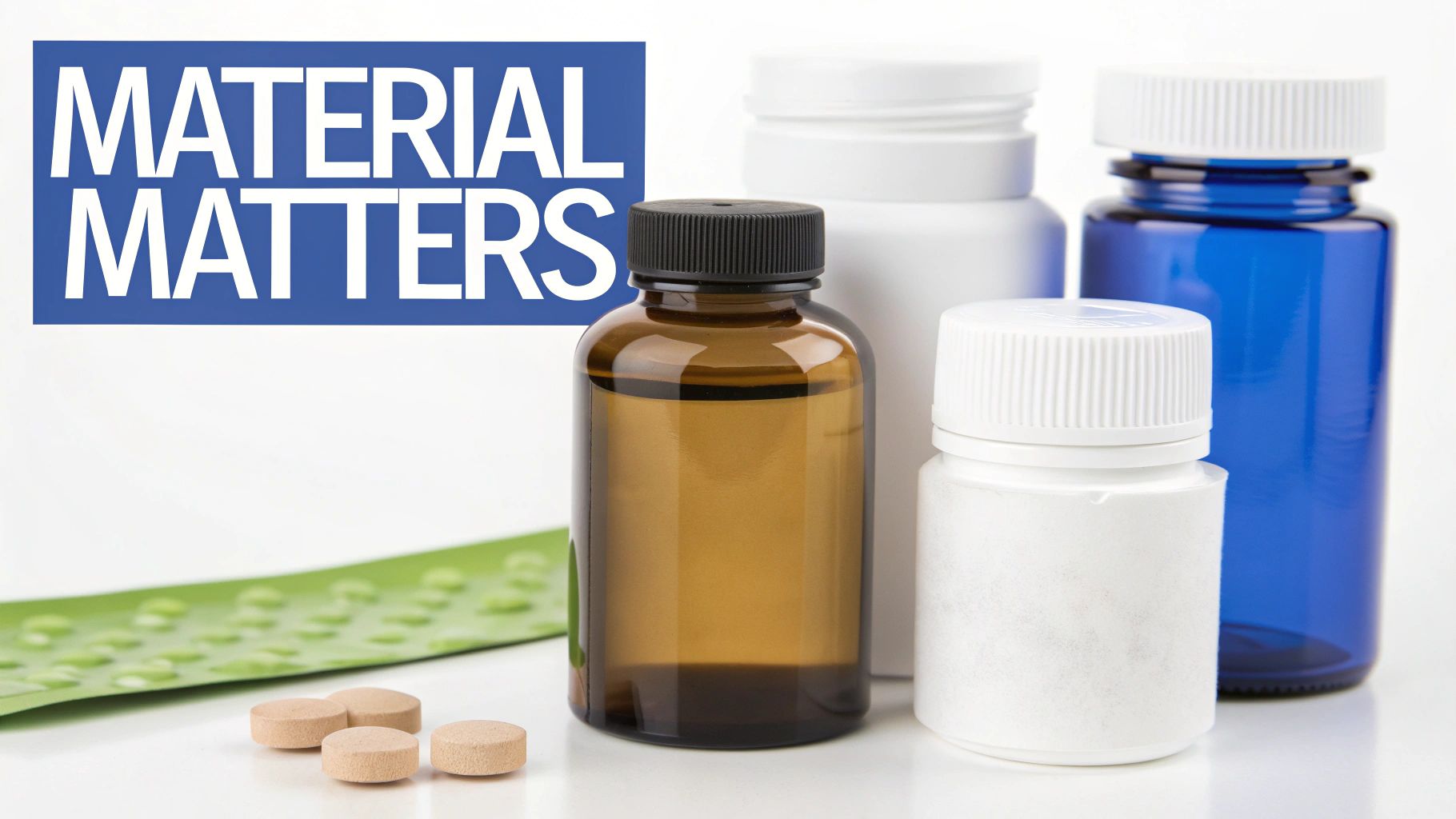
The material you choose for your custom supplement packaging is far more than just a container. It’s a critical decision that impacts product stability, shipping costs, and the very first impression your brand makes. This choice is your formula's first line of defense, and for liquids, the stakes are even higher—it must prevent leaks, protect against light and air, and feel good in the customer's hand.
Think about the message you're sending. A heavy, amber glass bottle immediately signals premium quality and a serious commitment to protecting sensitive ingredients. On the other hand, a lightweight, shatterproof PET bottle communicates convenience and practicality, a smart move for e-commerce brands looking to optimize shipping. As your manufacturing partner, our job is to help you navigate these choices, tailoring a solution for your product, brand, and budget.
Decoding Primary Packaging Materials
When we talk about primary packaging, we're referring to the actual bottle or container that houses your liquid supplement. It’s a crucial barrier, and each material brings something different to the table. Let's break down the most common options we work with and where each one really shines.
- PET (Polyethylene Terephthalate): This is the workhorse of the supplement world for a reason. PET is lightweight, almost impossible to shatter, and has fantastic clarity. It’s perfect for showing off your formula’s color and consistency, making it a go-to for e-commerce brands trying to minimize shipping costs and breakage.
- HDPE (High-Density Polyethylene): Need light protection but don't want to go the full glass route? HDPE is your answer. It's more rigid and opaque than PET, offering a solid barrier against light while still being durable and lightweight.
- Glass (Clear and Amber): Nothing says "premium" quite like glass. It's completely non-reactive, creating an unmatched barrier against oxygen and moisture. Amber glass is especially vital for light-sensitive ingredients, like those derived from our advanced botanical extraction processes, as it effectively filters out the harmful UV rays that can destroy potency.
Of course, it's never a simple decision. While glass feels high-end, its weight drives up shipping costs. This is where having a true partner comes in—we help you weigh these pros and cons based on your specific formula and distribution strategy, offering flexibility from pilot runs to full-scale production.
Comparing Primary Packaging Materials for Liquid Supplements
Choosing the right material for your liquid supplement can be tough. Below is a quick comparison table to help you weigh the key advantages and considerations for the most common options we see brands use.
| Material | Key Advantages | Considerations | Ideal For |
|---|---|---|---|
| PET | Lightweight, shatter-resistant, excellent clarity, cost-effective for shipping. | Less premium feel, lower barrier to oxygen compared to glass. | E-commerce brands, high-volume products, formulas not sensitive to oxygen. |
| HDPE | Opaque for light protection, durable, lightweight, good moisture barrier. | Not transparent, can feel less premium than PET or glass. | Light-sensitive formulas, dairy-based products, cost-conscious brands. |
| Glass | Superior barrier, inert (non-reactive), premium look and feel, recyclable. | Heavy (higher shipping costs), fragile (risk of breakage), higher upfront cost. | High-potency tinctures, premium botanical extracts, luxury wellness brands. |
| Amber Glass | All the benefits of glass, plus excellent UV light protection. | Same as clear glass: heavy, fragile, and more expensive. | Light-sensitive vitamins, advanced herbal extracts, premium tinctures. |
Ultimately, the "best" material depends entirely on your product's chemistry, your brand's positioning in the market, and your distribution strategy.
Functionality Beyond the Bottle
Great custom supplement packaging isn't just about the bottle; the dispensing mechanism is just as important. The right format must align with how your product is used and fit into your customer's lifestyle. A clumsy dispenser can ruin the user experience and even lead to incorrect dosing.
Let's look at some popular formats for liquids:
- Dropper Tops: Perfect for tinctures, concentrated serums, and essential oils. They allow for precise, measured dosing, which is key for potent formulas.
- Pump Dispensers: The go-to for syrups and larger-dose liquids. A pump provides a consistent, mess-free amount every time, making it ideal for daily routines.
- Spray Nozzles: Excellent for throat sprays and vitamin mists. A spray delivers a fine mist for quick absorption and targeted use.
- Single-Serve Sachets: The ultimate in convenience for travel packs, trial sizes, and on-the-go formulas. They're a fantastic way to introduce new customers to your product.
The Rise of Sustainable Packaging
Today’s consumers are smarter and more eco-conscious than ever. This shift is reshaping the supplements sector, with a clear demand for sustainable packaging. Moving from traditional rigid packaging to more flexible, branded options can cut shipping costs by 15-25%. More importantly, it resonates with the 70% of consumers who actively prefer sustainable choices, a crucial factor in a wellness market projected to soar past USD 50 billion.
As your partner, we help you explore innovative, sustainable options like PCR (Post-Consumer Recycled) plastics or fully recyclable glass. Communicating this choice on your label isn't just a trend; it's a powerful way to connect with your target audience on a deeper level.
For a deeper dive into material choices and design ideas for your outer packaging, check out this comprehensive guide to packaging boxes, which covers options that can complement your primary container. In the end, it’s all about creating a cohesive system that protects your formula, delights your customer, and truly reflects your brand’s values.
Designing Compliant Labels That Convert
A beautiful label is a fantastic marketing tool, but in the supplement world, compliance is king. Before it ever wows a customer, your custom supplement packaging must function as a legal document, ticking every FDA box. A stunning design means nothing if it gets your product recalled or earns you a warning letter for being misbranded.
The real art is in blending the must-have legal info with compelling branding so seamlessly that they enhance each other. This isn't about stifling creativity for the sake of compliance. It’s about building a label that works on every level—informing the customer, driving sales, and protecting your brand from day one.
The Anatomy of a Compliant Supplement Label
Diving into FDA regulations can feel like a maze, but it all comes down to giving the consumer clear, accurate information. Think of your label as having a specific anatomy, where every part has a job to do. The FDA doesn't just dictate what information you need, but often where it has to go and how it's formatted.
Here are the non-negotiable elements your label absolutely must include:
- Statement of Identity: This goes on the front of the package (the Principal Display Panel) and clearly states what the product is, such as "Dietary Supplement".
- Net Quantity of Contents: Also on the front, this tells the customer exactly how much product is inside, whether that's fluid ounces for a liquid or a capsule count.
- Supplement Facts Panel: This is the most heavily regulated part of the label. It has a very specific format, required font sizes, and a set order for ingredients.
- Ingredient List: Any "other ingredients" not in the Facts panel (like flavors or preservatives) get listed separately, always in descending order by weight.
- Manufacturer/Distributor Information: Your company’s name and address must be on the label, giving customers a point of contact.
Demystifying the Supplement Facts Panel
The Supplement Facts panel is the heart of your label’s compliance. It’s a standardized chart that consumers know and trust, so nailing it is critical. This panel must accurately list every single dietary ingredient, its amount per serving, and the percentage of the Daily Value (%DV) it provides, if one exists.
For a liquid herbal supplement, this gets even more specific—you have to state the part of the plant used (like Echinacea purpurea root) and the extraction ratio. Every detail matters, from the heavy black line separating main nutrients from vitamins to the exact order of ingredients. This level of detail is something our in-house quality and compliance teams handle every day.
For a much deeper dive into these specifics, our guide offers a complete breakdown of navigating dietary supplement labeling guidelines.
Health Claims vs. Structure/Function Claims
One of the easiest traps for new brands is making unapproved health claims. The FDA has drawn a very bright line between what you can and can’t say about your product's effects. Getting this right is crucial for avoiding regulatory trouble.
- Structure/Function Claims: These are statements about how an ingredient supports the body's normal structure or function. Think "Calcium builds strong bones" or "Supports a healthy immune system." These are generally acceptable.
- Health Claims: These are a red flag for regulators. They explicitly link your product to reducing the risk of a disease. For example, claiming your supplement "prevents osteoporosis" is a disease claim, and it's strictly forbidden.
Any structure/function claim you make must be paired with the mandatory FDA disclaimer: “This statement has not been evaluated by the Food and Drug Administration. This product is not intended to diagnose, treat, cure, or prevent any disease.” This isn't a suggestion—it's an absolute requirement to keep your custom supplement packaging compliant.
Preparing for Retail and E-commerce Success
Beyond the label's text, your packaging must be ready for the real world, whether it's sitting on a store shelf or moving through an Amazon FBA warehouse.
- Scannable Barcodes: A crisp, high-quality, scannable barcode (UPC for retail, FNSKU for Amazon) is non-negotiable for inventory. A blurry or poorly printed barcode is a recipe for a logistical nightmare.
- Tamper-Evident Seals: To ensure customer safety and build trust, a tamper-evident seal is standard practice. This could be a shrink band over the cap or an inner seal, demonstrating product integrity.
- Material and Finish Choices: The label material itself is a big deal. A waterproof label stock is a must for liquids to prevent ink from smearing. The finish—be it matte, gloss, or a soft-touch texture—also plays a huge role in your brand's perceived quality. If you're exploring options, there are great resources on different types of custom product labels for packaging branding that can help you find the perfect fit.
As your manufacturing partner, we see ourselves as your collaborator in all of this. We work with you to ensure your vision comes to life on a label that is not only beautiful and effective but also fully compliant and ready for success.
From Digital Dieline to Finished Product
Turning your brand’s vision into a physical, shelf-ready product is a detailed dance between creative design and precision manufacturing. It all starts with a foundational blueprint called a dieline.
Think of the dieline as the architectural plan for your custom supplement packaging. Whether it’s a simple label for a tincture bottle or a complex carton, this file is everything.
This flat, 2D template maps out every single cut, fold, and score needed to create the final three-dimensional package. It’s the most critical file in the entire process, ensuring your artwork, logo, and regulatory text land exactly where they should. An inaccurate dieline can bring a production run to a screeching halt.
The Dieline is Your Foundation
Before a single drop of ink is used, your packaging partner provides a dieline specific to your chosen container. This isn't a generic template; it’s custom-built for the exact dimensions of your bottle, jar, or box.
One of the most common—and avoidable—reasons for production delays is submitting artwork that doesn’t precisely fit this blueprint. It's a rookie mistake that can cost you time and money.
As your manufacturing partner, we provide these dielines immediately. This first step is collaborative. It ensures your designer is building on a solid, production-ready foundation from the get-go, which cuts out guesswork and expensive revisions.
The goal is to create a label that's not just attractive but also completely compliant, which means nailing the Supplement Facts, claims, and barcodes.
This simple flow shows the core checkpoints of label design. It all comes down to factual accuracy, compliant claims, and a functional barcode before anything goes to print.
From Digital Proof to Physical Product
Once your artwork is finalized on the correct dieline and submitted, we jump into the proofing stage. This is a crucial quality control checkpoint. Here, we double- and triple-check that every element—from the tiny text in the Supplement Facts panel to your brand’s logo—is perfectly placed and legible.
- Digital Proofing: First, you’ll receive a digital proof, usually a PDF, showing exactly how your artwork looks on the flattened dieline. This is your chance to give the final thumbs-up or request minor tweaks before we commit to physical printing plates.
- Color Matching: Brand colors are non-negotiable. We get it. To ensure absolute consistency, we use the Pantone Matching System (PMS). This system allows us to replicate your brand’s exact shades, guaranteeing the final product is a perfect match and maintains brand integrity across every single unit produced.
A seamless transition from design to production all comes down to clear communication and a partnership mindset. By working closely with you during the proofing stage, we spot potential issues early, guaranteeing the final packaging aligns perfectly with your vision and our rigorous quality standards.
Application and Final Quality Control
With the labels or cartons printed, the final step is application. Inside our cGMP-certified, UL certified, and FDA-registered facility, this process is meticulously controlled. Our innovative cold-fill technology helps protect the integrity of your liquid herbal supplements during this stage.
High-speed, automated equipment applies each label to your bottles with precision, ensuring perfectly consistent placement and a smooth, bubble-free finish every time.
This is where all the careful planning truly pays off. Throughout the entire run, our quality control team performs constant checks to verify labels are applied correctly and the final packaged product meets all specifications. This obsessive attention to detail reinforces our commitment to reliability and on-time delivery. The product you receive is exactly what you approved.
For brands wanting to see the full picture, exploring the capabilities of different supplement contract manufacturers can offer real insight into how a true partner manages the journey from concept to launch. It’s this end-to-end management that transforms a simple digital file into a powerful brand asset.
Juggling Costs, MOQs, and Green Packaging
Taking your supplement from idea to a tangible product is a massive leap for any e-commerce founder or brand manager. This is where the rubber meets the road—balancing your vision with the hard numbers of manufacturing. Two terms every entrepreneur must get familiar with are MOQ (Minimum Order Quantity) and cost-per-unit. These aren't just industry jargon; they are the factors that define your initial investment, shape your inventory strategy, and ultimately, determine your profit margins.
Getting a handle on these concepts is the first step toward making smart, sustainable decisions for your business. It's never about just finding the cheapest option. It’s about finding the right partner who offers the flexibility you need to grow.
Why MOQs Are a Thing and How They Affect Your Price
Minimum Order Quantities are a non-negotiable part of manufacturing for one simple reason: efficiency. Setting up machinery for a specific bottle shape, a unique label, and your exact liquid formula takes a significant amount of time and resources. MOQs ensure that the cost of that setup is spread out over enough units to make the production run worthwhile.
Here’s the fundamental relationship to grasp:
- Higher MOQs almost always mean a lower cost-per-unit. It's far more efficient to produce 10,000 units in one go than to run the same setup ten times for 1,000 units each.
- Lower MOQs offer flexibility but come at a higher cost-per-unit. This is ideal for testing a new product or for startups on a tight budget, but your profit margin on each sale will be tighter.
Finding a manufacturing partner who offers real flexibility is the secret sauce. We’ve designed our operations to support brands at every stage—from small pilot runs with low MOQs to massive, full-scale production. This lets you launch with confidence, without tying up capital in inventory before you even know what sells.
For a new brand, a high MOQ can feel like a brick wall, locking up cash in unsold inventory. This is exactly why our partnership approach is so critical. We work with our clients to find a starting point that fits their budget and business plan, helping them scale up intelligently as their sales grow.
The Surge in Demand for Sustainable Supplement Packaging
Modern consumers don't just buy products; they buy into brands that reflect their values. And in the wellness world, no value is more powerful right now than sustainability. When your brand invests in eco-friendly packaging, it sends a powerful signal that you care about more than just the bottom line. In fact, a staggering 73% of consumers say they'd change their buying habits to reduce their environmental impact.
This isn't a passing fad—it's a major shift in what the market expects. For your custom supplement packaging, that means looking past the standard plastic bottle and exploring materials that tell a much better story.
Several great options are gaining serious momentum:
- PCR (Post-Consumer Recycled) Plastics: This material is made from plastics that consumers have already recycled. Using PCR reduces the need for new fossil fuels, shrinks your packaging's carbon footprint, and keeps waste out of landfills.
- Recyclable Glass: Glass is, and always has been, a premium and highly sustainable choice. It's infinitely recyclable with zero loss in quality, and its non-reactive nature makes it ideal for preserving the purity of potent liquid supplements.
- Lightweighting: This is the smart practice of designing packaging to use less material from the start, without sacrificing strength. A lighter bottle means lower shipping weights, which reduces the carbon footprint across your entire supply chain.
How to Tell Your Green Story
Choosing sustainable materials is only half the job. You have to tell your customers what you've done. Don't just assume they’ll know your bottle is made from 50% PCR plastic—tell them, loud and clear.
This is where your label design becomes an incredible marketing tool. A simple icon or a short, clear statement on your packaging can make a world of difference.
Think about adding direct, honest messaging like:
- "This bottle is made with post-consumer recycled plastic."
- "Please recycle this bottle and join our commitment to a healthier planet."
- "Proudly packaged in a 100% recyclable glass container."
This kind of transparency does more than just inform; it builds a real connection with your audience. It shows that your commitment to wellness isn't just about personal health, but about the health of our planet, too. As your manufacturing partner, we can help you source these materials and figure out the best way to weave this vital messaging into your custom supplement packaging design. It's how you ensure your brand stands out not just for its quality, but for its conscience.
Your Top Supplement Packaging Questions, Answered
Jumping into the world of custom supplement packaging always brings up questions, especially when you're launching or scaling a brand. We get it. As your partner from concept to launch, we believe in being completely transparent.
Here are the straightforward, no-fluff answers to the questions we hear most from health and wellness entrepreneurs.
Contract Manufacturer vs. Contract Packager: What's the Real Difference?
This is a big one, and getting it wrong can create serious supply chain headaches.
A contract manufacturer (CM), like us, handles everything from A to Z. We source the raw ingredients, perform advanced botanical extractions, blend your unique formula, and then bottle and package it. It all happens under one roof in our cGMP, UL certified, and FDA-registered facility. We are your complete R&D and production partner.
A contract packager, or "co-packer," only handles the very last part of the process. You'd have to get your product made somewhere else and then ship it to them just to put it in bottles and boxes.
Going with a full-service CM means you skip the logistical nightmare of shipping bulk liquids between different vendors. This saves you time, slashes the risk of contamination, and simplifies quality control infinitely.
So, How Much Will My Custom Packaging Actually Cost Per Unit?
The "per-unit" cost for your custom packaging boils down to three main factors:
- Order Volume: It's a simple game of economies of scale. The more you order, the lower your cost per unit will be because initial setup costs are spread out over a bigger run.
- Material Choice: There's a definite cost difference between materials. Premium choices like amber glass will have a higher per-unit cost than a standard PET plastic bottle.
- Label Complexity: A simple, glossy label is less expensive than one with all the bells and whistles, like multi-color printing, foil stamping, or a soft-touch matte finish.
We lay out all costs upfront with clear, transparent pricing. Our goal is to help you strike the perfect balance between a high-end feel and a price point that keeps your profit margins healthy.
What's a Realistic Turnaround Time for a Packaging Project?
We pride ourselves on speed and reliability. While every project is unique, a typical timeline from when you sign off on the final dieline to having finished, packaged products in hand is usually in the 4-6 week window.
What’s the most common holdup we see? Incomplete or incorrect artwork. It happens. By providing your design team with exact dielines from day one and keeping communication open during proofing, we can help you dodge preventable delays and hit your launch date. On-time delivery isn't just a goal; it's our commitment.
As a flexible manufacturing partner, we're set up to handle small pilot runs for testing the market just as easily as we handle full-scale production runs to meet surging demand. That agility lets you grow your business smartly without tying up cash in inventory before you're ready.
Your custom packaging is your single most important piece of marketing. It's the first thing your customer sees. Getting it right takes a partner who lives and breathes the details of design, compliance, and production. We're here to walk you through every single step, ensuring your final product isn't just stunning but is also 100% compliant and ready to win on any shelf or e-commerce site.
Ready to create packaging that not only protects your product but also grabs your customers' attention? Partner with Triton Nutra Group and let our 25+ years of expertise bring your vision to life. Request a free quote today!
