How to Create Your Own Supplements: A Founder's Guide
Learn how to create your own supplements from formulation to launch with our step-by-step private label guide.
 Get a Free Quote Today!
You have an idea for a revolutionary liquid supplement. Fantastic. But turning that vision into a successful product in a competitive market requires a clear, strategic process. This isn't just about mixing ingredients; it's about building a trusted brand and a valuable business asset.
The journey from a validated concept to a market-ready launch involves navigating formulation, compliance, and production. To do it right, you need a solid plan and an expert manufacturing partner who acts as an extension of your R&D team from day one.
Your Blueprint for Launching a Supplement Brand
Jumping into the supplement industry is about more than a great product concept—it's about executing a sharp business strategy. For brand managers, e-commerce founders, and wellness entrepreneurs, you’re not just making a supplement; you’re building a brand that earns customer trust. Think of this guide as your practical, business-first roadmap. We're here to cut through the jargon and show you how to turn your vision into a profitable product line.
The path to creating your own supplements has a few distinct, critical phases. This simple visual breaks down the high-level journey from that first lightbulb moment to a full-scale launch.
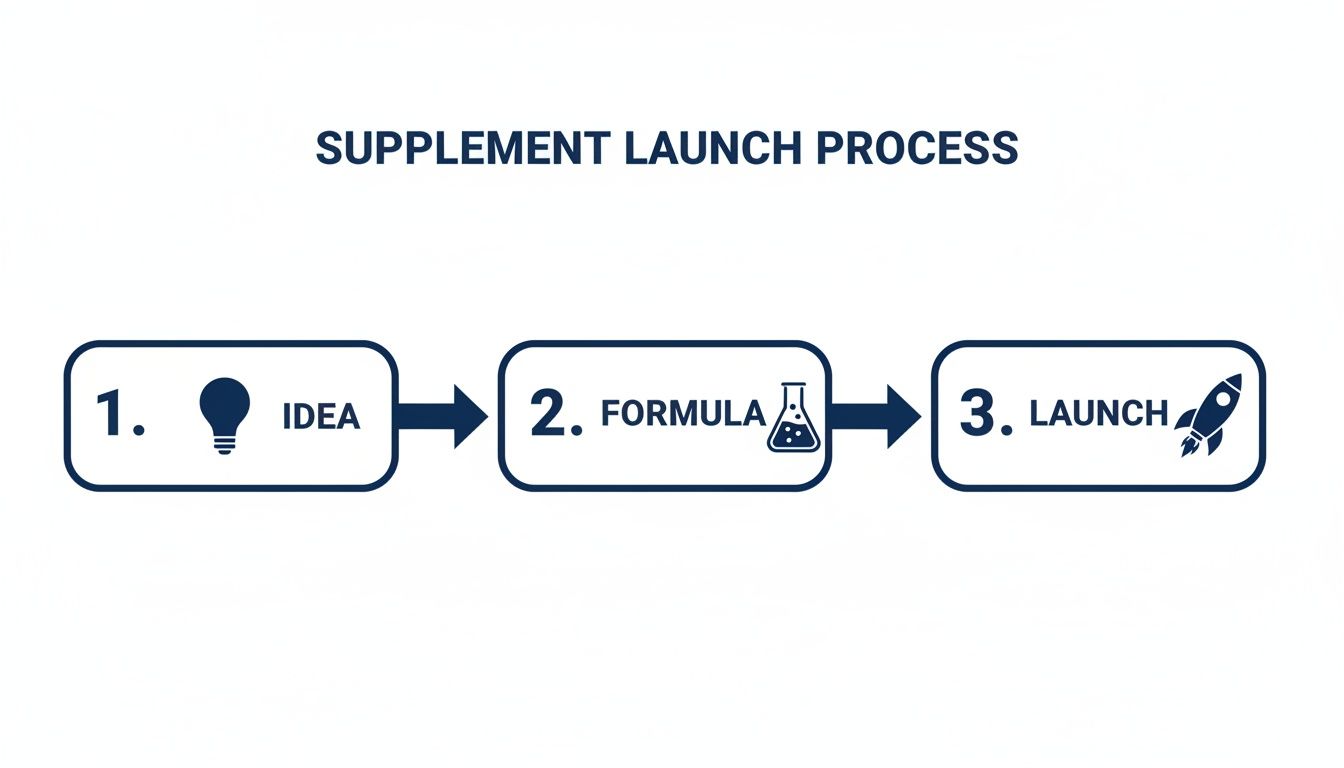
As you can see, a successful launch is a structured progression, not one big event. Each stage builds on the last, demanding a true partnership approach to handle everything from formulation science to the nitty-gritty of manufacturing logistics.
Seizing a Multi-Billion Dollar Opportunity
There has never been a better time to get into the supplement game. The global dietary supplement market is enormous and growing rapidly. Industry estimates value the market at USD 190–210 billion in 2024–2025, with projections showing it could more than double by the early 2030s.
Let that sink in. For a direct-to-consumer (DTC) brand, capturing even a tiny slice of that pie—say, just 0.01%—can translate into millions in annual revenue. That makes the effort to create your own supplements a very real, commercially significant venture.
Key Takeaway: Our goal is to provide a concrete action plan, not generic advice. This guide is your blueprint, packed with the insider knowledge you need to navigate ingredient sourcing, cGMP compliance, and scaling production without the usual headaches.
To help you visualize the path ahead, we've put together a high-level roadmap. This table breaks down the main phases of a private label supplement launch when working with a manufacturing partner like Triton.
Private Label Supplement Launch Roadmap
| Phase | Key Activities | Primary Goal |
|---|---|---|
| Phase 1: Idea & Validation | Market research, competitor analysis, identifying a target niche, validating customer demand. | To confirm a viable market opportunity for your product idea before investing in development. |
| Phase 2: Formulation & Sourcing | Ingredient selection, developing a unique formula, sourcing raw materials, stability testing. | To create a safe, effective, and stable product formula that meets your brand's quality standards. |
| Phase 3: Compliance & Production | cGMP manufacturing, FDA-compliant labeling, third-party testing, small-batch or full-scale production. | To produce a market-ready product that is compliant, safe, and manufactured to the highest quality standards. |
| Phase 4: Launch & Logistics | Finalizing packaging, setting up fulfillment (e.g., FBA), creating marketing materials. | To successfully bring the finished product to market and ensure smooth order fulfillment for customers. |
Each phase in this roadmap represents a critical milestone. Successfully navigating them is what separates the brands that thrive from those that never get off the ground.
Laying the Foundation for Success
A winning launch depends on more than just a stellar product; it needs a rock-solid business foundation. That means understanding the entire ecosystem, from your initial market research all the way to final fulfillment logistics. For in-depth training on setting up your brand for long-term growth, resources like the Seller Success Academy can be an incredible asset.
As we move through this guide, we’ll break down each step of the process. We’re going to give you actionable insights to help you build a brand that stands out for its quality, efficacy, and relevance. For a deeper dive into those crucial first steps, be sure to check out our guide on how to start a supplement business.
Finding Your Niche in a Crowded Market
A brilliant supplement idea is a great start, but it's not enough to build a brand. Before you think about ingredients or manufacturing, you must answer the most important question: who will buy this, and why? The supplement aisle, both virtual and physical, is overflowing. Success means carving out your own dedicated space.

This isn't about a gut feeling. It’s about a sharp, tactical approach to market research that uncovers real, unmet needs. The goal isn't to be a decent choice for everyone; it’s to become the only choice for a specific group of people.
Defining Your Ideal Customer Avatar
Generic products get lost in the noise. To create a supplement that truly connects, you need a crystal-clear picture of your ideal customer. This "avatar" is more than a demographic—it's a deep dive into their lifestyle, struggles, and aspirations.
Who are you actually trying to help?
- High-achieving Millennials? They are likely seeking clean-label nootropics and stress-support formulas to sharpen focus and boost productivity.
- Active Gen Xers? They might need powerful joint support and recovery aids to maintain peak performance in the gym and in life.
- Health-conscious Baby Boomers? This group often prioritizes cognitive health, mobility, and cardiovascular wellness with ingredients backed by solid science.
Each group has different pain points, values different product attributes, and uses different online channels. Knowing exactly who you're serving will drive every decision you make, from ingredient selection to the tone of your marketing copy.
Analyzing the Competitive Landscape
Once you've zeroed in on your audience, it's time to see what they're already buying. This isn't about copying competitors; it's about identifying their weaknesses to create your market opening. Take a hard look at the top players in your chosen category and ask some tough questions.
Where are they falling short?
- Formulation Gaps: Are they using outdated ingredients, ineffective dosages, or inconvenient formats like large, hard-to-swallow pills?
- Brand Messaging: Is their marketing bland and generic? Does it fail to connect with the real emotional drivers of your target avatar?
- Customer Feedback: Dive into the reviews. What are customers actually saying? Pay close attention to complaints about taste, texture, effectiveness, or side effects.
This is where real opportunities are born. A common complaint about a leading product's chalky taste could be your golden ticket to introduce a delicious, easy-to-take liquid alternative. This is a proven strategy to create your own supplements that solve a specific problem the market leader is ignoring.
Your R&D Partner from Concept Through Launch: This is where a manufacturing partner should act as a strategic collaborator. We help brands analyze competitor formulas, identify ingredient gaps, and suggest innovative liquid delivery systems that can become your key differentiator.
Capitalizing on Market Trends
The wellness industry moves fast. The most successful brands anticipate where the market is headed. Today, consumers are ditching one-size-fits-all products for solutions that feel personalized.
This shift toward personalization, preventive health, and immunity support is creating massive demand for custom supplements. Major consumer surveys show significant behavioral changes, especially among younger generations who embrace products supporting their appearance, immunity, and wellness goals. Targeting these segments—like active adults, aging consumers focused on joint and cognitive health, or Gen Z—aligns your product with the fastest-growing categories. You can get more insights into these consumer shifts by reading about the dietary supplements market.
This trend intelligence lets you build a product that feels forward-thinking. For example, developing an alcohol-free liquid tincture for stress support directly taps into the modern consumer's desire for clean ingredients and convenient formats.
By locking down a specific audience, a clear market gap, and a compelling trend, you build a foundation for a supplement that doesn't just launch—it lasts.
Developing a Standout Supplement Formula
You've nailed down your niche. Now comes the exciting part: creating the formula that will define your brand. This is where your vision transitions from an idea into a tangible product. It's a careful blend of science, market awareness, and artistry—especially for high-absorption liquid supplements.
A great formula isn't a list of trendy ingredients. That "kitchen sink" approach rarely works. Instead, think of it as a carefully constructed symphony where every component has a purpose and works in harmony to deliver a specific, noticeable result.
Selecting Science-Backed Ingredients
Your product's credibility begins and ends with its ingredients. Today's customers are savvy; they do their homework, read labels, and expect transparency. This means every ingredient you choose must have a clear, justifiable purpose, backed by solid evidence.
Look past the marketing hype and into the clinical data. It's not just about the ingredient itself, but its specific form and dosage. Take magnesium, for example. Magnesium citrate aids digestion, glycinate promotes relaxation, and L-threonate supports cognitive function. Picking the right form is critical for your product to deliver on its promise.
This is where a good manufacturing partner becomes an extension of your team. We help you sort through the science to identify:
- Clinically-Validated Dosages: We ensure you include an effective amount of each active ingredient, not just a meaningless "fairy dusting."
- Bioavailable Forms: We help you select forms the body can actually absorb and use—a massive advantage of liquid formulas.
- Synergistic Combinations: We can identify ingredients that enhance each other's effects, like adding vitamin C to an iron supplement to dramatically improve absorption.
The Art of Botanical Extraction
For herbal supplements, the extraction process is everything. It dictates the potency, purity, and overall quality of your final product. Many traditional methods rely on high heat or harsh solvents like alcohol, which can damage delicate plant compounds and leave unwanted residues.
This is where modern science offers a significant upgrade. We specialize in an advanced alcohol-free, cold-fill extraction process. This gentle, temperature-controlled method carefully coaxes active botanicals from the plant material, preserving their full-spectrum benefits without compromising integrity. For today’s clean-label consumer, this isn't just a better scientific process; it's a powerful selling point.
Think of us as your R&D department. We’ll walk you through these technical details, helping you select the perfect extraction method for each botanical to ensure your formula is as potent in the bottle as it is on paper.
Sourcing and Supply Chain Integrity
You can develop the most brilliant formula, but if your raw materials are subpar, so is your product. Sourcing is a non-negotiable pillar of quality. Every ingredient must come from a vetted, reputable supplier who provides a Certificate of Analysis (CofA) for every batch.
This document is your proof. It verifies the ingredient's identity, purity, and potency while confirming it’s free from contaminants like heavy metals, pesticides, or microbes. A transparent supply chain is more than a compliance task; it’s a cornerstone of your brand’s story. Being able to tell your customers you use only premium, traceable ingredients builds incredible trust. To go deeper on this, check out our guide to nutraceutical formulation development.
Perfecting Flavor and Stability
When you create your own supplements in liquid form, you face a two-front battle: efficacy and taste. An amazing product that tastes awful will not generate repeat business. Flavor profiling is a detailed process of balancing the natural, often earthy tastes of herbal extracts with palatable, natural flavors and sweeteners.
The goal isn't just to make it tolerable, but to make it enjoyable to take daily. This requires multiple rounds of testing and tweaking to mask bitterness without using excessive sugar or artificial additives.
Once the formula and flavor are dialed in, it must pass stability testing. This non-negotiable step ensures your product remains safe, potent, and effective throughout its entire shelf life.
- Accelerated Stability: This test uses elevated heat and humidity to simulate long-term storage in a much shorter timeframe.
- Real-Time Stability: The product is monitored under normal storage conditions for its full proposed shelf life, typically 18-24 months.
This isn't optional—it's required for cGMP compliance and provides the data needed to confidently set an expiration date. It guarantees that the last customer receives the same quality as the first.
Choosing Your Manufacturing Partner
Once you’ve perfected your formula on paper, you’ve reached the most critical decision in this process: choosing your manufacturing partner.
This isn't just about finding a facility that can mix ingredients. You're looking for a collaborator who will become an extension of your team and a guardian of your brand's reputation. The right partner ensures your product is safe, compliant, and consistently high-quality. The wrong one can stop you before you even start.
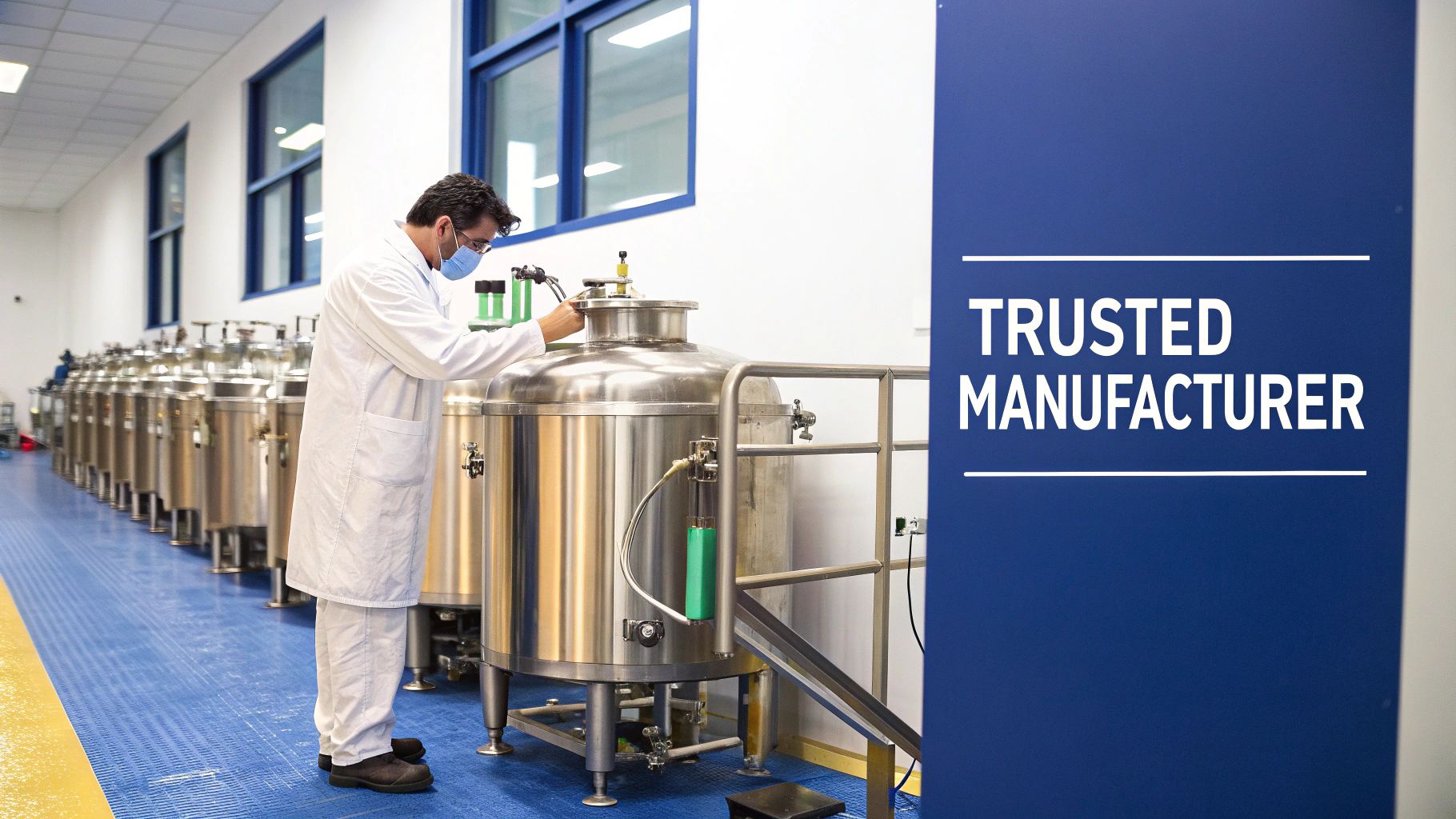
Your manufacturer’s facility is where your brand’s promise of quality is either upheld or broken. Vetting potential partners means taking a deep dive into their certifications, processes, and philosophy. This choice will impact everything from your product's effectiveness to your ability to scale.
Decoding Essential Quality Certifications
When you talk to manufacturers, you’ll hear a lot of acronyms. It’s vital to understand what they mean for your business and customers. These aren't just badges for a website; they are legally binding commitments to quality and safety.
Here are the absolute non-negotiables:
- cGMP (Current Good Manufacturing Practice): This is the baseline. Mandated by the FDA, cGMP certification means a facility follows strict protocols for every step of production—from how they quarantine and test raw materials to how they release the final product. It’s the system that ensures consistency and quality.
- FDA-Registered Facility: This confirms the manufacturer is on the FDA's radar and subject to inspections. It's the minimum entry requirement for any legitimate US supplement producer.
- UL Certified: This third-party certification goes a step beyond the basics. UL conducts its own regular, rigorous audits of manufacturing facilities to verify they meet (and often exceed) industry standards for quality control and safety. It’s an independent stamp of approval that shows a serious commitment to excellence.
A Quick Word on Partnership: Think of these certifications as your brand's insurance policy. A partner who proudly displays their UL and cGMP credentials demonstrates transparency and a proactive approach to quality. That protects your customers and your business.
A manufacturer’s certifications tell you they follow the rules. But their internal processes show you how well they play the game.
Pilot Runs vs. Full-Scale Production
One of the biggest hurdles for a new brand is inventory risk. Ordering 10,000 units of an unproven product can be a death sentence for a startup's cash flow. This is where a manufacturer’s flexibility becomes critical.
A partner who understands this will offer a tiered approach to production:
- Pilot Runs: These are small-batch runs, typically 500 to 1,500 units. A pilot run lets you test the market, gather real customer feedback, and refine your marketing before committing to a massive inventory order.
- Full-Scale Production: Once your product gains traction, you can confidently move to larger runs. The ideal partner has the capacity to scale with you seamlessly, so you can meet rising demand without the stress of switching suppliers or facing production delays.
The ability to start small is a game-changer. It dramatically lowers your financial risk and lets you build momentum organically. When vetting partners, always ask about their Minimum Order Quantities (MOQs) and their process for scaling up from a pilot run.
Vetting a Partner on Quality and Transparency
Beyond certifications and production capacity, the right partner operates with a culture of total transparency and obsessive quality control. They should be able to walk you through exactly how they ensure your product's integrity at every stage.
Key questions to ask:
- How do you handle third-party testing? Every batch of your finished product should be sent to an independent lab to verify its potency, purity, and safety. Ask for sample reports.
- Can you walk me through your raw material sourcing and quarantine process? A top-tier manufacturer will have a rock-solid system for vetting suppliers and testing every ingredient before it enters the production floor.
- What documentation can you provide for e-commerce compliance? A partner experienced with platforms like Amazon FBA or Shopify will know exactly what paperwork you need to get your product listed without issues.
Choosing your manufacturing partner is a complex step, but it's the foundation of your brand. For a more detailed checklist, our guide on finding a reputable supplement manufacturer can help you dig deeper. Find a partner as invested in your success as you are.
Nailing Your Launch Logistics
You’ve done the hard work. You’ve locked in a winning formula and partnered with a top-notch cGMP manufacturer. You officially have a product.
But a product in a warehouse isn’t a business. The final sprint is about the logistical details of getting that product into your customers' hands. Even the most incredible supplements can stumble if these details aren't managed perfectly.
It’s about making a seamless leap from production to the commercial world, which means perfecting your packaging, labeling, and fulfillment from day one.
Designing Compliant and Compelling Packaging
Your packaging is your brand's first handshake. It must look amazing while being fully compliant with regulations. For liquid herbal supplements, that process starts with the bottle itself.
- Bottle Selection: Most brands choose amber or cobalt blue glass for a reason. It protects delicate botanicals from UV light, which can degrade them and reduce potency.
- Dispensing Method: How will customers use the product? A graduated dropper allows for precise dosing, while a pump top might be better for other applications. This choice is all about user experience.
- Secondary Packaging: A custom-printed box instantly elevates perceived value and gives you more real estate to tell your brand's story and highlight key benefits.
Your manufacturer should be a great resource here, pointing you toward standard bottle and cap options that are stable and customer-friendly. It's a balance of form and function.
Navigating FDA Labeling Requirements
Let's be clear: your product label is a legal document, not a marketing brochure. The FDA has very specific rules about what it must contain. Getting this wrong can lead to serious headaches like fines or seized inventory.
The most critical piece is the Supplement Facts panel. It has a rigid, standardized format you must follow. This includes detailing the serving size, servings per container, and a full list of every dietary ingredient with its exact amount per serving.
Your label also needs to include:
- The product's statement of identity (e.g., "Herbal Supplement").
- The net quantity of contents (e.g., 2 fl oz / 60 mL).
- The name and business address of the manufacturer or distributor.
- The mandatory FDA disclaimer for any structure/function claims: "This statement has not been evaluated by the Food and Drug Administration. This product is not intended to diagnose, treat, cure, or prevent any disease."
Partnership in Practice: A great manufacturing partner won’t leave you to figure this out alone. They’ll provide a label template with all required regulatory fields formatted. This hugely reduces the risk of compliance errors and lets your designer focus on branding.
Streamlining Fulfillment for E-commerce Success
In e-commerce, speed and accuracy are everything. Whether you're launching on Shopify or Amazon, your fulfillment and inventory management must be buttoned up from the start.
A forward-thinking manufacturer is also a logistics partner. They should prepare your finished product for immediate entry into your sales channels. For a platform like Amazon, that means having all the right documentation ready, like Certificates of Analysis (CofAs) and proof of cGMP manufacturing.
An experienced partner will have an "FBA-ready" packet of documents prepared, saving you from the back-and-forth that can stall your launch for weeks. Once your product is ready to ship, expanding your reach often means getting into retail. Knowing the ins and outs of pitching your product to retail buyers can unlock massive growth beyond your direct-to-consumer channels.
Planning Realistic Launch Timelines
A common pitfall for new brands is over-optimism about timelines. A realistic schedule is crucial for managing cash flow and timing your marketing campaigns. While every project is unique, here’s a general breakdown of what to expect.
Estimated Timelines for Private Label Launch
This table provides a ballpark idea for each major phase, from finalizing your idea to having a product ready to sell.
| Phase | Estimated Duration | Key Deliverable |
|---|---|---|
| Formulation & Quoting | 2–4 Weeks | Finalized formula and production quote. |
| Sourcing & Testing Raw Materials | 3–5 Weeks | All ingredients received, tested, and approved. |
| Pilot Batch & Stability Testing | 4–6 Weeks (Initial) | A small, market-ready batch for final approval. |
| Full-Scale Production Run | 4–6 Weeks | Your complete inventory, manufactured and bottled. |
| Third-Party Lab Testing | 1–2 Weeks | Final verification of the finished product's potency. |
All told, you’re looking at a total timeline of roughly 14 to 23 weeks from locking in the formula to having a market-ready product. This can shift based on formula complexity or ingredient availability, but it’s a solid framework for planning. This is the moment your hard work pays off—with a compliant, high-quality product ready for your first customer.
Frequently Asked Questions About Creating a Supplement
Diving into the supplement world brings up a lot of questions. As your potential R&D partner, we believe in being completely transparent. Here are straight answers to the questions we hear most often from entrepreneurs like you.
What Is a Typical Minimum Order Quantity (MOQ)?
Minimum Order Quantities (MOQs) vary widely. It's not uncommon for large facilities to demand huge commitments of 5,000 to 10,000 units per run. For a new brand, that’s an intimidating financial hurdle.
A modern manufacturing partner knows that agility is key. We've built our model on flexibility, offering pilot runs with MOQs as low as 500 to 1,500 units. This lets you test your product in the market, get real customer feedback, and build momentum before sinking significant cash into inventory. When vetting manufacturers, ask how they plan to scale with you.
How Much Does It Cost to Start a Supplement Brand?
To get a custom supplement off the ground, you should realistically budget between $10,000 to over $50,000. The final number depends heavily on your formula's complexity and order quantity.
The main costs to account for are:
- Research & Development (R&D): Initial formulation work and benchtop testing.
- Raw Materials: Sourcing high-quality, verified ingredients.
- Manufacturing: The production run itself.
- Third-Party Testing: Independent lab verification for potency and purity.
- Packaging: Bottles, droppers, labels, and any outer boxes.
A transparent partner will provide an itemized quote so you can see exactly where every dollar is going. This helps you budget properly and avoid surprises.
How Long Does It Take to Launch a Custom Supplement?
From a locked-in concept to a product ready to sell, the timeline is generally 4 to 9 months. The process involves a series of critical steps, each with its own timeline.
Here's a realistic breakdown, with some phases overlapping:
- Formulation & Flavoring: 4–8 weeks
- Ingredient Sourcing & Verification: 4–6 weeks
- Stability Testing: 12–16 weeks
- Full-Scale Production & Bottling: 4–6 weeks
- Packaging Design & Printing: 2–4 weeks
Working with a partner who has streamlined processes, reliable supply chains, and proactive project management can significantly accelerate this timeline. A great partner will provide a detailed project plan with clear milestones so you’re never left wondering where things stand.
Key Insight: Stability testing is almost always the longest part of the process, but it is absolutely non-negotiable. It proves your product will remain safe and effective for its entire shelf life, protecting your brand's reputation and your customers' trust.
Private Label vs. Contract Manufacturing: What’s the Difference?
These terms are often used interchangeably, but they represent two different business models.
Private label means putting your brand on a pre-made, off-the-shelf formula from the manufacturer. It's faster and usually cheaper, but it offers zero product differentiation. You're selling the same formula as dozens of other brands.
Contract manufacturing, which is our specialty, is a true partnership. We work with you to create a completely unique, proprietary formula from scratch. You have full control over the ingredients, dosages, flavor, and delivery format (like our specialty, alcohol-free liquid tinctures). This is the path for building a brand that truly stands out and solves a specific problem for your ideal customer.
Ready to take your supplement idea from a concept to a reality? At Triton Nutra Group, we’re more than just a manufacturer; we’re your dedicated R&D partner. We’ll guide you through everything from formulation and compliance to full-scale production. Let’s build something incredible together. Request a free consultation today.
